
Flat Roof Leaking? Here Are the Solutions That Actually Fix It - Not Just Slow It
Why the Drip Misleads You on a Queens Flat Roof
Value and price are different calculations. And the first real insight that separates a useful flat roof leaking solution from an expensive mistake is this: the visible drip is almost never where the roof is failing, which means the fix has to start with tracing how water moved across the assembly - not smearing sealant on the obvious spot.
If I asked you where the water showed up, would that answer help me much? Probably not. Water on a flat roof doesn't travel in a straight line. It enters somewhere, finds a low-resistance path underneath the membrane, slides along a seam or deck board, and exits wherever there's an opening - the way someone might drive into Woodside, take a wrong turn, and end up exiting in Maspeth without planning to. That hardware-store roof cement you picked up might cover the drip inside, but it doesn't touch the actual breach. That's not a fix. That's a stain with hope painted over it.
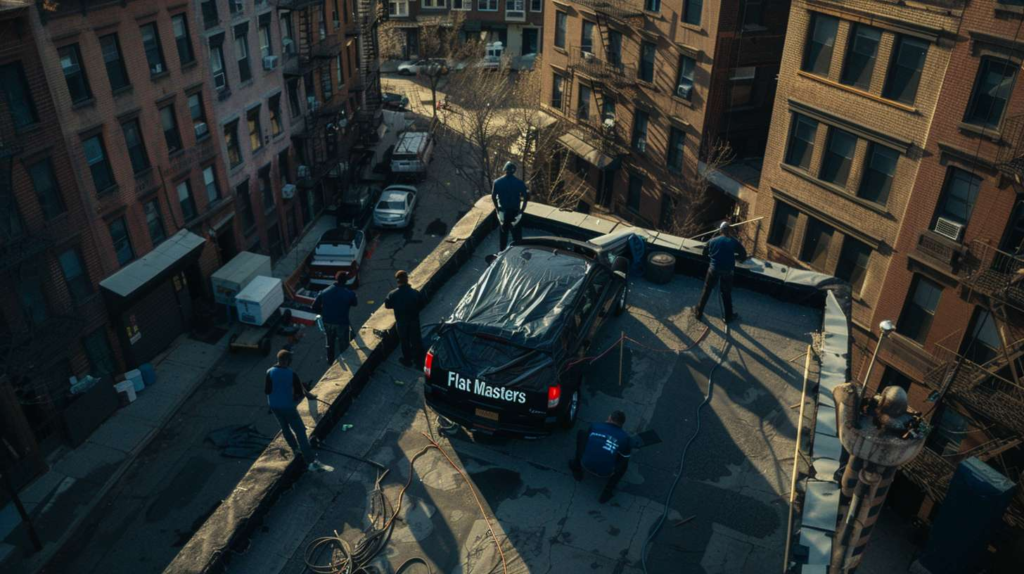
At the drain first. The real failure map on Queens flat roofs almost always starts at one of a few known weak points: drain sumps, seam edges, flashing at parapet walls, pipe penetrations, membrane splits near rooftop equipment, or transitions where the roof meets a vertical surface. These are the entry candidates - and as Marisol Vega, with 19 years in flat roofing and a specialty in tracking stubborn leak paths, I've learned that finding the right one requires reading how and where water pools before you ever look at the ceiling below. The sort-first approach - classify the failure before choosing the repair - is the only way to avoid paying twice for the same leak.
The interior stain, wall bubbling, or drip line does not identify where the roof is breached. These are exit points - not entry points.
- Don't coat over wet insulation. Trapping moisture accelerates deck rot and voids any warranty on a new coating.
- Don't caulk random seams near the stain. The breach is likely elsewhere, and you've now added a false data point to the failure map.
- Don't assume the nearest rooftop mark is the source. Blistering and surface staining often appear downslope from the actual entry point.
Match the Fix to the Failure, Not the Symptom
When a Targeted Repair Is Enough
Here's the part people usually hate hearing: not every leak means full replacement, but not every leak deserves a patch either. I remember a February call in Rego Park, around 6:15 in the morning, sleet still coming sideways, where the owner swore the leak was over the back office. I got up there and found the real issue was a split at a drain sump twenty feet away, and the water had been traveling under the membrane before it ever showed up inside. That ceiling stain was a witness, not the criminal - and if we'd patched the ceiling side or caulked around the nearest curb, the leak would have come back with more damage behind it. Queens buildings throw this problem constantly: aging modified bitumen that's been through a decade of wind-driven storms, rooftop HVAC units with heavy foot traffic worn into the membrane around them, clogged drains that hold water long enough to find every weak seam. You read those conditions correctly, or you read them wrong and the owner calls again in six weeks.
When Soaked Materials Change the Job
A leak that comes back was never really fixed. When insulation gets saturated, when the deck surface has started to soften, when you're looking at the fourth layer of seam tape over the same split - those conditions push the solution well past a targeted repair. And honestly, I have no patience for the cosmetic patch cycle. A shiny surface that makes an owner feel like something got done is not the same as a roof that stays dry. Repeated patching is a false economy I've watched cost property owners two and three times what a real repair would have run the first time, and I'll say that plainly every time someone asks.
The right solution category comes down to three things: the membrane's overall condition, how far moisture has actually spread through the assembly, and whether the failure is isolated to one spot or showing up in a pattern. That distinction - isolated versus systemic - is what separates a $600 repair from a $6,000 partial reroof. Both can be the right answer. The wrong answer is choosing one without knowing which you're dealing with.
| Roof Condition Found | Actual Solution | What It Includes | When It Works | When It's the Wrong Move |
|---|---|---|---|---|
| Isolated seam split, dry insulation | Targeted membrane repair | Clean, cut back, and re-weld or re-torch the failed seam; seal perimeter | Single failure point, membrane otherwise sound, no recurring history | Wet insulation is present beneath the split or multiple seams are failing nearby |
| Flashing separation at parapet or curb | Flashing replacement | Remove failed termination, install new metal or modified bitumen flashing, re-seal counterflashing | Flashing is the confirmed entry point and field membrane is still intact | Membrane under the flashing is also deteriorated - you'll be back in one season |
| Saturated insulation beneath membrane | Partial reroof with material removal | Cut out wet section, replace insulation, install new membrane layer over affected zone | Saturation is contained to one area; surrounding membrane is bonded and dry | Moisture has spread throughout - partial work will chase a moving boundary |
| Multiple failed areas, aged membrane | Full roof replacement | Full tear-off, deck inspection, new insulation, new membrane system, drainage correction | Membrane is at end of life, repairs outnumber remaining sound field, deck damage found | Only one or two failure points with otherwise sound material - over-solution wastes budget |
| Active leak during storm, unknown source | Emergency containment + follow-up diagnosis | Temporary tarp or roof cover, interior protection, scheduled diagnostic once conditions allow | Leak is active and interior protection is the immediate priority | Treating emergency containment as a finished repair - it is never a finished repair |
- Temporary tarp or roof cover
- Sealing an active opening
- Interior protection (buckets, barriers)
- Short time horizon - hours, not months
- Does not identify source or moisture spread
- Leak tracing from entry point to exit
- Moisture assessment of insulation and deck
- Removal of wet materials where needed
- Membrane, flashing, or drainage repair/replacement
- Follow-up testing before job is closed
What a Real Diagnosis Looks Like Before Anyone Talks Price
Last summer on a roof off Northern Boulevard, I was looking at a bakery in Astoria that had been "repaired" four times in one summer with silver coating. The whole roof smelled like hot sugar and wet asphalt - the kind of smell that hits you before you even step off the ladder. Every patch looked shiny enough to impress somebody who'd never had to stand on a working roof. But once we cut into it, the insulation was soaked so badly it squished under my boot like sponge cake. Four shiny surfaces, one completely saturated assembly underneath. The coating didn't solve the leak. It just made the problem invisible until the damage had spread far enough that partial replacement was the only real path forward. Surface treatments cover. They don't dry out a roof that's already drinking water.
Think of water like a subway rider who missed its stop and kept going. It doesn't exit where it boarded. It finds the next opening - maybe two cars down, maybe two stops later. On a flat roof, water enters at a membrane split near an HVAC curb on one side of the building, rides under the seam toward the low point, takes a side route along a parapet transition, and finally exits through a ceiling penetration in a back room that has nothing to do with any of those locations. By the time the stain appears, the water's made a full commute. That's why, before you approve any repair, you'll want to ask the roofer for three specific things: the confirmed entry point, the documented travel path, and the boundary of wet material. If they can't give you all three, they're guessing - and you'll pay for the guess twice.
It saves time and helps get you to the right solution faster. Know these six things:
- When the leak first appeared - exact date or approximate timeframe
- Whether it happens only during heavy rain or also after light precipitation or snowmelt
- Exact interior locations affected - which rooms, which floors, proximity to walls or fixtures
- History of prior repairs or coatings - what was done, when, and by whom if known
- Roof age if known - even a rough estimate helps narrow material type and expected wear
- Whether water is near lights, electrical panels, or HVAC equipment - this changes urgency immediately
Queens Leak Scenarios and the Solution That Usually Fits
Do you want the roof to look patched, or stay dry through the next storm?
Those are two different outcomes, and not every contractor is clear on which one they're delivering. I had a landlord in Ridgewood call me at 9:40 p.m. during a thunderstorm because water was pouring through a light fixture on the third floor. He wanted to know if I could just seal the spot tonight and deal with the rest later. I told him what I ended up writing on his estimate: emergency stop is one job, real leaking flat roof solutions are another, and mixing those two up - treating a temporary seal like a finished repair - costs people thousands. The solution that fits your situation depends on what's actually happening: isolated seam split, drain-area failure, parapet flashing separation, a recurring leak hiding under a coating, or an active storm emergency. Each one has a different answer. And Flat Masters is built to tell you which one you're dealing with before any work starts.
| Scenario | Typical Scope | Estimated Price Range |
|---|---|---|
| Isolated seam or membrane split | Targeted repair, dry insulation confirmed | $450 - $1,200 |
| Parapet or curb flashing failure | Flashing removal and replacement, counterflashing seal | $600 - $2,000 |
| Drain-area failure with localized saturation | Drain repair/replacement, wet insulation removal, partial membrane patch | $1,200 - $3,500 |
| Recurring leak under existing coating, widespread saturation | Partial reroof - wet section removal, new insulation, new membrane layer | $3,000 - $8,500+ |
| Active storm emergency | Emergency containment - tarp, temporary cover, interior protection | $300 - $900 (containment only; diagnosis and repair quoted separately) |
- Water near or dripping from electrical fixtures
- Active ceiling bulge or bubble filling with water
- Leak actively entering during a storm
- Multiple rooms or floors taking water simultaneously
- Drain backup with visible ponding and no runoff
- Old stain on ceiling with no active drip in dry weather
- Isolated blister on membrane with no interior water
- Cosmetic coating cracks spotted during a dry inspection
- Minor surface wear found in routine maintenance check
Small Mixed-Use Buildings ▾
Multifamily Row Buildings ▾
Commercial Roofs with Equipment ▾
Questions Worth Asking Before You Approve Any Repair
Before you sign off on any flat roof repair, ask the contractor four direct questions: What specifically failed and where is the confirmed entry point? How far has moisture spread through the insulation and deck? What materials are being removed and replaced - not just covered? And what happens if the opening reveals saturation that extends beyond the initial repair boundary? A roofer who can answer all four clearly, without deflecting to vague language about "addressing the issue," is someone who has actually diagnosed the roof. The ones who can't tend to be the ones who leave you calling again in three months. Use these questions as a filter, not a formality.
Can a flat roof leak be fixed without replacing the whole roof? +
How do you know if insulation is wet under the membrane? +
Will coating solve my leak? +
Can the roof be repaired during bad weather? +
How fast should I act if the leak stopped after the storm? +
-
✔
Licensed and insured - fully credentialed for residential and commercial flat roofing work in New York -
✔
Emergency leak response - available for active leaks that can't wait for a scheduled appointment -
✔
Documented repair scope before work begins - you see exactly what's being done and why before anyone picks up a tool -
✔
Local Queens coverage - serving property owners across the borough, from Flushing to Far Rockaway
The leak you're dealing with has an actual entry point, a travel path, and a wet-material boundary - and none of those three things is visible from the inside. If you want the real answer found and the repair matched to the actual failure, call Flat Masters for a Queens flat roof leak diagnosis - not another temporary patch that sends you back to square one next season.