
Wind Doesn't Just Blow Things Around - Here's What It Actually Does to a Flat Roof
Usually, wind damage to a flat roof starts long before anything dramatic goes missing - no torn sheets, no obvious blow-off, just lifting, pressurizing, and loosening happening quietly at the perimeter while the storm is still going. This article breaks down exactly what wind is doing up there, where Queens roofs tend to give it away first, and what to pay attention to in the hours and days after a gusty event.
What Wind Is Really Doing Up There
Usually, the most destructive thing wind does to a flat roof isn't the gust you hear rattling the windows - it's the sustained pressure working its way under edge metal, through seam gaps, and around flashing terminations before anything actually separates. Think of it as air finding a classroom loophole: one small opening teaches the whole roof how to fail in sequence, with each loosened component making the next one easier to compromise. The membrane doesn't have to peel back dramatically for real damage to be underway.
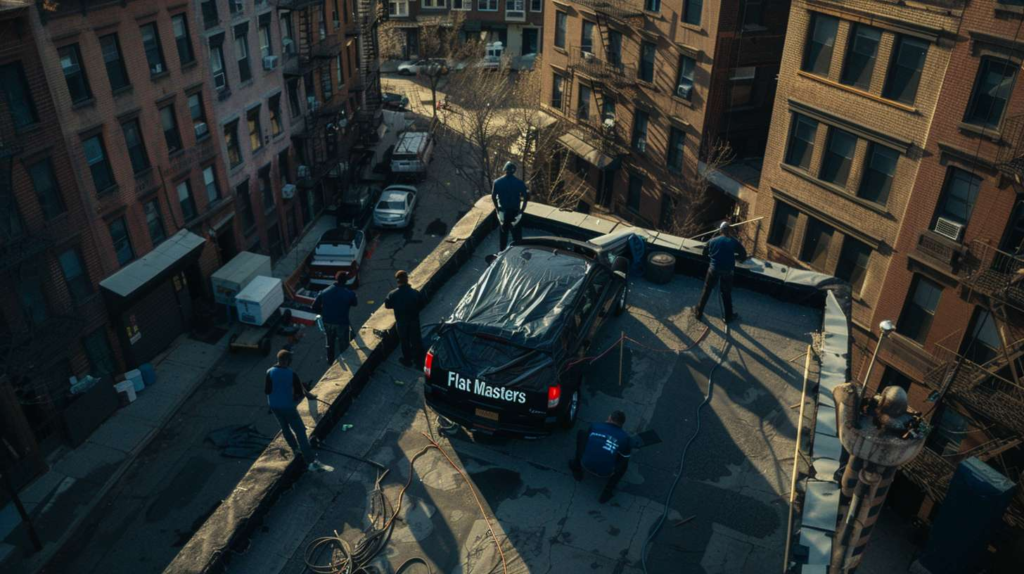
At the roof edge, that's where I start. Perimeter metal, corner terminations, and coping caps are the first places to check because that's where wind gets its best mechanical leverage - it's pressing up from below and pulling outward at the same time. And once that edge lifts even slightly, pressure travels inward under the membrane, working fasteners and seams loose from the outside in, quietly, until water has a path it didn't have before the storm.
| What Wind Does | Where It Starts | What You Might Notice Inside | Why It Gets Missed |
|---|---|---|---|
| Edge metal lifts | Perimeter corners and drip edges | Faint drip line near the exterior wall | No dramatic blow-off, so the roof looks intact from ground level |
| Membrane flutter and flex | Mid-field membrane where air is pumping under | Ceiling noise or low whistling sound | Attributed to HVAC, ducts, or building settling |
| Seam stress and fatigue | Lap seams pulled repeatedly by pressure cycles | Leak appears days after the storm has passed | No rain during the storm means wind isn't suspected |
| Flashing loosening | Parapet walls, curbs, and equipment bases | Water entry near rooftop unit or parapet base | Interior stain doesn't line up with where the flashing separated |
Where Queens Roofs Usually Start Giving It Away
Perimeters, drains, and patched transitions
Here's the part people in Queens usually don't expect: the most vulnerable spots on a flat roof aren't random - they're almost always at transitions, and Queens has more of them per block than most boroughs. Older mixed-use buildings along the Ridgewood, Bayside, and Jamaica Avenue corridors often carry two or three reroof cycles layered on top of each other, with patched rear additions, rooftop equipment curbs, and parapets at varying heights all creating spots where one system ends and another begins. As Maribel Sosa - who's been working flat roofs in Queens since 2002, with a specialty in tracking down post-wind leak paths on exactly these kinds of older mixed-use buildings - puts it, the roof doesn't fail at the strongest point; it fails at the junction where two contractors made different decisions in different decades.
I remember one March morning in Ridgewood, just after 6:30, when a bakery owner called because flour bags were getting damp near the rear prep table. The wind the night before hadn't torn the roof open the way he expected - it had lifted the edge metal just enough to start a chain reaction under the membrane. I stood there with my coffee going cold, showing him how the damage started at one loose corner and traveled farther than the visible stain inside suggested. That's the nature of edge lift on a layered roof: the entry point is small, and the spread is not.
And once that edge disturbance starts, drains, scuppers, and patch boundaries become the next weak points in line. Water that gets under the membrane doesn't pool where it entered - it migrates to the lowest spot it can find, which is usually a drain area or an old patch seam. That's why the ceiling stain two rooms over isn't necessarily a separate problem; it might be the same wind event expressing itself through a different path entirely.
| Myth | Fact |
|---|---|
| "If nothing blew off, the roof is fine." | Wind damage to a flat roof almost never shows up as missing material. Edge lift, seam stress, and loosened flashing happen before anything separates completely - especially on Queens roofs with multiple repair layers. |
| "Leaks show up immediately after the storm." | Seam stress and partial flashing lifts can leave the membrane technically waterproof through one storm and fail on the next rain - sometimes days later. A dry ceiling the morning after a wind event isn't a clean bill of health. |
| "Only old roofs get wind damage." | Newer roofs with improper perimeter fastening or undersized edge metal can fail in wind just as quickly as aging systems. Installation quality matters more than age at the perimeter. |
| "The damage is always directly under the interior stain." | On flat roofs - especially those with insulation boards and multiple patch layers - water migrates horizontally before it drops. The wind entry point can be six feet or more from the stain on the ceiling below. |
| "Wind only matters on high-rises." | Two- and three-story mixed-use buildings in Queens are exposed to the same uplift forces. In many cases, shorter buildings in open corridors catch more direct horizontal wind than taller buildings sheltered by neighbors. |
Subtle Signs After a Windy Night
- 🔊 New whistling or low hum - especially under suspended ceilings or near exterior walls, even without any visible leak
- 🫧 Bubbling or blistering near the roof edge - small raised areas in the membrane that weren't there before the storm
- 🔩 Visibly lifted or bent edge metal - even a slight gap at the drip edge or corner cap is worth investigating right away
- ↗️ Wrinkles or tension lines running away from the perimeter - a sign the membrane shifted under pressure and didn't fully return
- 🌫️ Damp insulation smell inside - musty or earthy odor after a storm often means wet insulation board, which is invisible from above
- 💧 Leak appearing after the rain has stopped - water that migrated through stressed seams during the storm can drip through hours later, once the interior material is fully saturated
When the Leak Shows Up Late
I had a customer in Bayside say this once - "but nothing blew off" - and he kept coming back to that point like it settled the question. He and his wife had called me out after a summer thunderstorm, and by 8 p.m., with that sticky post-rain heat still sitting on the roof, I was peeling back a section near the drain and showing them where the seams had been stressed and weakened long before the leak became obvious. No missing pieces, sure. But the membrane had been flexing under pressure all night, and the seam bond near the drain had fatigued to the point where it just needed one more wet cycle to open up. The roof can be injured before it becomes obviously wet - and by the time a stain shows on the ceiling, that injury has usually had some time to spread.
Common Questions After a Wind Event
How a Good Inspection Follows the Air Path
The first question on the roof
If I'm standing on your roof with a marker, I'm asking one question first: where did the air get in? The inspection follows a logical sequence - edge metal, corners, flashing terminations, exposed seams, fastener points, insulation board softness, and drain surrounds - because that's the order wind uses to compromise a flat roof system. Here's the insider detail that catches people off guard: the interior stain is almost never directly below the wind entry point, especially on roofs with two or three patched layers underneath the current surface. Water that gets under the membrane finds the path of least resistance through insulation and substrate, and that path usually runs toward a drain or an old patch boundary - not straight down. So if you're trying to diagnose from inside the building, you're already working from a misleading clue.
What gets checked before anyone talks repair
One of the strangest jobs I had was above a small tax office near Jamaica Avenue, right after a gusty November cold front rolled through. The tenant only noticed a whistling sound over the suspended ceiling - no drips, no staining, nothing dramatic. When I got up there, the wind had been pumping air through a gap at the perimeter so steadily that it was flexing part of the membrane like a lung - expanding and contracting with each gust, working the seam a little more open every cycle. Subtle, but the kind of thing that becomes a significant repair if it goes unaddressed through another storm season. I sketched the air path on a piece of scrap membrane backing right there on the roof, labeled the pressure arrows, and showed the building manager exactly what was moving and why. If your roof sounded different after the storm, would you know where that pressure was escaping?
Post-Wind Flat Roof Inspection Sequence
Walk the full edge of the roof checking drip edge, corner metal, coping caps, and termination bar. Any gap, lift, or separation here is the most likely wind entry point and gets marked before anything else.
Follow any wrinkles or tension ridges running inward from the perimeter. Press along lap seams to check for separation or softness. Seam stress from a wind event often shows up as subtle bubbling or a slight ridge along the bond line.
Press the membrane around drains and scuppers - these areas tend to collect migrating moisture. Soft, spongy sections indicate saturated insulation board underneath, which won't dry out on its own and will hold moisture against the deck.
Parapet base flashing and equipment curb flashing are high-risk spots after wind. Check for lifted edges, exposed fasteners, or gaps where the flashing has pulled away from the vertical surface. Water entry here often shows up inside the building well away from the actual gap.
Map out where damage begins, how far it extends, and which components are affected. This separates a targeted repair from a situation where the system has failed broadly enough to require a larger section or full replacement conversation.
⚠️ Don't Patch Before the Inspection
Smearing roof cement or generic sealant over a lifted area before a professional looks at it is one of the more expensive guesses a property owner can make. It can seal water that's already gotten underneath, trapping it against the insulation and deck where it continues doing damage invisibly. It also masks membrane movement - which is often the clearest diagnostic clue for where the wind actually entered. A patch applied in the wrong place makes the real entry point harder to find and the eventual repair less precise.
What To Do In The First Day After A Wind Event
Blunt truth: a flat roof doesn't have to look destroyed to be wind-damaged. In the first 24 hours after a notable wind event, document what you can from safe access - the date and time of the storm, any interior symptoms like ceiling noise, drips, or odor, and photos of the perimeter from ground level or a safe rooftop vantage point if you already have routine access up there. Note any changes in how the building sounds or smells. My honest opinion, after doing this work in Queens for over two decades, is that waiting for a more obvious leak usually makes diagnosis harder for everyone and more expensive for the building owner. Hidden spread doesn't stop moving just because the ceiling is still dry.
Think of it like lifting a tablecloth one finger at a time - nobody drops anything right away, but the situation is getting worse with every lift. If wind damage is still localized to one perimeter section or a single compromised seam, a targeted repair is genuinely possible. Wait through another rain cycle or two, and that localized problem often becomes a saturated insulation field or a deck issue that changes the repair conversation entirely. Early action keeps options open. That's not a sales pitch - it's just what the progression looks like.
Before You Call About Flat Roof Wind Damage - Gather This First
- ☐ Storm date and approximate time the wind peaked
- ☐ Building address and whether roof access is available (interior hatch, exterior ladder, or key required)
- ☐ Photos of the perimeter edge, corners, and any visible lifted metal - only from a safe vantage point
- ☐ Interior leak or stain locations, including which room, how close to the exterior wall, and when it first appeared
- ☐ Any new sounds after the storm - whistling, low hum, or dripping without a visible source
- ☐ Whether the roof has prior patches, known repair history, or multiple layers
- ☐ Whether any water is near electrical panels, elevator equipment, or tenant machinery
Most Revealing Areas
Edges, corners, drains, and flashing terminations
Damage May Appear
Same day - or several days after the storm
Visible Blow-Off Required?
No - most flat roof wind damage leaves nothing visibly missing
Best Next Move
Get an inspection before any patching or sealing
If your Queens building had wind, heard noise from above, showed lifted edges, or developed a leak that seemed to appear out of nowhere after a storm - call Flat Masters. We'll follow the air path, show you exactly what's happening, and tell you straight what it'll take to fix it. - Maribel Sosa, Flat Masters