
TPO Roofing Is One of the Best Flat Roof Systems Around - Here's Why It's Chosen
Until the real cause is fixed, no membrane is going to save a flat roof that was never properly set up to carry one. TPO flat roof installation is one of the strongest moves you can make for a low-slope building in Queens-but only when the building is a good fit and the installation is disciplined, especially at seams and transitions. Get that right, and TPO earns every bit of the reputation people give it.
Performance starts at the seam, not at the brochure
At the seam welder, TPO starts proving why people choose it. It's a clean, heat-welded membrane system that doesn't rely on adhesives hoping for the best-it fuses. When the building is a good candidate and the crew respects the system, TPO delivers reflective efficiency, long seam life, and a finished appearance that holds up through Queens winters and humid July stretches without buckling or separating. That's not marketing. That's what a properly executed TPO flat roof installation actually does.
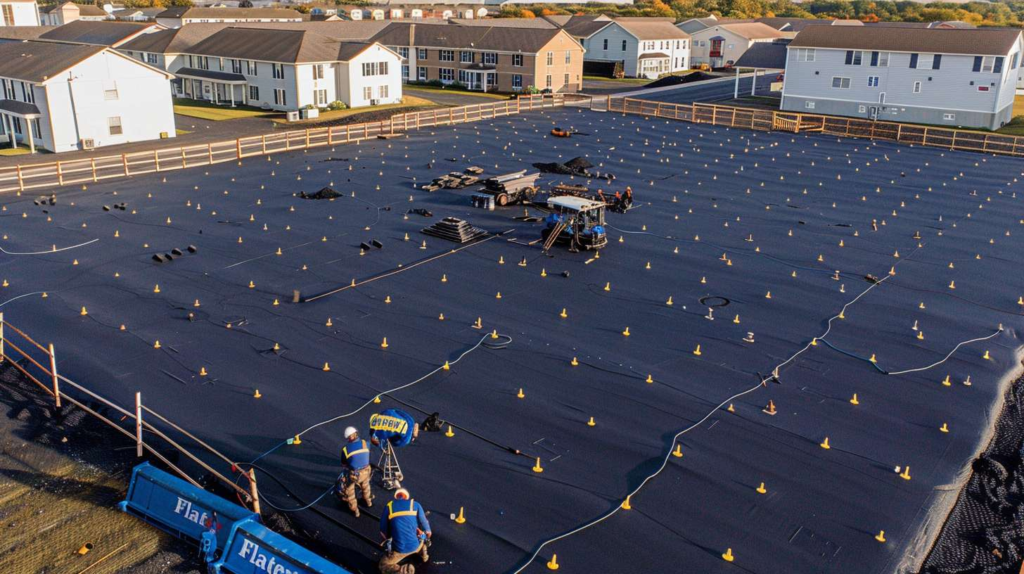
Before we talk about how to install TPO flat roof systems, is the roof underneath ready to carry a precision membrane? Because TPO rewards system discipline-true substrate, clean prep, honest detailing, and controlled seams. I'm Kendrick Vale, and with 9 years installing TPO flat roofs in Queens, I've watched the membrane perform brilliantly when the entire setup is tuned correctly and struggle badly when it isn't. Think of it the way I think about a tuned bike: the frame has to be right, the joints have to be clean, the alignment has to be dialed in, and the drag has to be managed-because the system only rides fast and durable when every connection is doing its job. A sloppy base, rushed corners, or lazy edge work turns a high-performance membrane into a callback waiting to happen.
Material reputation means nothing if the substrate and details are not behaving like they belong in the same system
The membrane is only as smooth as the truth underneath it
At the seam welder, TPO starts proving why people choose it. One muggy July morning in Long Island City, I was on a low-slope commercial roof where the owner kept calling TPO "that white plastic stuff"-like the color meant it was somehow fragile or cheap. Then I set up the welder and walked him through what a properly fused seam actually is. I watched him shift from skeptical to genuinely interested the second he understood that a welded seam is not the same thing as a glued hope. System discipline changed his mind, not a sales pitch.
A TPO roof system is a lot like a tuned bike-light, efficient, and excellent, but only if the joints, alignment, and setup are right. I had a Ridgewood homeowner ask me how to install TPO on a flat roof because he'd watched enough online clips to think the hard part was mostly rolling it out straight. It was a breezy March afternoon, and the real conversation turned to substrate prep, fastening pattern, and edge conditions almost immediately. Here's the thing about Queens residential roofs and light commercial buildings along corridors like Northern Boulevard and Jamaica Avenue-awkward penetrations, tight parapet walls, mixed-use details, and access constraints are the norm, not the exception. That's exactly where TPO either becomes elegant or becomes a problem, depending entirely on how seriously the installer treats the setup.
| Installation Factor | Why It Matters to TPO | What Happens If It's Rushed |
|---|---|---|
| Substrate Condition | TPO conforms to whatever is underneath-lumps, soft spots, and inconsistencies don't disappear under the membrane | Membrane telegraphs every flaw, creates stress points, and fails at inconsistencies over time |
| Fastening / Attachment Logic | Correct fastening pattern holds the insulation and membrane against wind uplift without overloading the deck | Under-fastened assemblies lift at perimeters and seams; over-fastened areas create puncture risk |
| Seam Welding Quality | A properly welded seam is stronger than the membrane itself-this is the system's core reliability point | Under-welded seams delaminate; over-welded seams burn through-both fail on a probe test or under weather stress |
| Edge Conditions | Edges are where wind uplift starts and water finds its way in-termination bars and edge metal have to be exact | Loose edge conditions allow the membrane to peel back from the perimeter, compromising the entire assembly |
| Transition Details | Where the flat plane meets a vertical surface-parapet, curb, wall-is where the membrane faces the most movement stress | Poorly finished transitions crack, pull away, or pond water exactly at the point where leaks cause the most damage |
| Penetration Detailing | Every pipe, HVAC curb, and drain interrupts the membrane plane and needs a clean, stress-free transition | Rushed penetration details are the single most common source of TPO failures-they look fine from a ladder and leak from below |
The field membrane is the easiest part of a TPO flat roof installation to get right. Long-term performance rises or falls at the corners, penetrations, edges, and transitions-not in the middle of the open field. A roof that looks perfect from the ground or from a ladder can be quietly failing at every detail point where the membrane changes direction or meets another material. Field appearance is not the whole story. It rarely is.
The strongest argument for TPO is not hype - it is fit, speed, and controlled detail work when the building suits it
I still remember the owner calling it "white plastic" before the demo changed his mind. That skepticism is common, and honestly, understandable-TPO doesn't look technical sitting on a roll. But the second you show someone a welded seam tested with a probe, or explain the reflective efficiency numbers compared to a modified bitumen cap sheet baking in August, the material stops looking like a budget option and starts looking like what it actually is: performance equipment. The skepticism doesn't survive contact with how the system actually works.
Here's the blunt truth: TPO rewards clean technique and punishes lazy transitions. A small warehouse in Astoria sticks in my mind because another crew had already botched sections of a TPO flat roof installation by rushing the transitions around penetrations. From the ladder, the field looked fine-clean, white, flat. Up close, kneeling with a probe in hand, the corners were telling a completely different story. I explained to the manager that TPO doesn't fail because it's weak. It fails when people treat the detail work like cooldown laps-something to rush through once the main event is done. The main event is the detail work.
My take? TPO gets judged by bad installs far more often than by bad material. That's not a defense of every TPO product on the market-it's an observation built from nine years of seeing the same pattern repeat. And here's the insider truth worth holding onto: before you hire anyone for a TPO flat roof installation, ask them specifically how they handle corners, penetrations, and edge transitions. Not how fast they can roll the field-that part's not hard. If they can't walk you through their corner and penetration process in detail, that's your answer. The field is where the work happens. The corners are where the installer proves themselves.
-
✔
How is the substrate prepared? - A contractor who can't describe a substrate inspection process hasn't thought past the membrane. -
✔
What fastening or attachment pattern is planned? - This should match the deck type, insulation spec, and local wind zone requirements. -
✔
How are seams verified after welding? - Probing every seam is not optional; it's the confirmation that the system is actually sealed. -
✔
How are corners handled? - Custom-cut corners welded with a hand welder, not just patches slapped over them. -
✔
How are penetrations detailed? - Every pipe boot, drain, and curb needs a clean, stress-free transition-ask them to describe the process specifically. -
✔
What edge treatment is included? - Termination bars, edge metal, and drip edge should be part of every complete TPO installation scope. -
✔
What conditions would make you stop and correct before proceeding? - A contractor who has a real answer to this question is one who respects the system enough to protect it.
When the building is a good fit and the install is disciplined, TPO earns its reputation the honest way
The right system still needs the right rider
At the seam welder, TPO starts proving why people choose it-and that's not just a process point, it's a verdict. The seam welder is where system discipline either shows up or doesn't, where the installer's knowledge either translates into durable performance or exposes every shortcut taken before it. TPO works best when it's chosen for the right roof and installed by people who treat it like performance equipment, not just another roll to unspool. If you want a flat roof system that delivers real efficiency, clean longevity, and a result that doesn't apologize for itself after the first hard season-this is the one. But only when the whole system is respected, from substrate to seam to edge detail.
| Myth | Fact |
|---|---|
| "TPO is just white plastic." | TPO is a heat-weldable thermoplastic membrane engineered for UV resistance, thermal movement, and seam strength-the color is a feature, not a red flag. |
| "If the field looks good, the install is good." | The field is the easiest part. Long-term performance is decided at corners, penetrations, and transitions-none of which are visible from the ground. |
| "TPO is easy enough that details matter less." | TPO's clean appearance makes it look forgiving. It isn't. It requires precise welding temperature, correct fastening, and disciplined detail work at every transition. |
| "Bad TPO jobs prove the material is weak." | Bad TPO jobs prove that workmanship matters. The membrane is consistently strong when installed correctly-failures trace back to technique, not product quality. |
| "Fast install always means efficient install." | Speed in the field is fine. Speed at penetrations, corners, and edges is where callbacks come from. Efficient means correct and durable-not just quick. |
If you want your TPO flat roof evaluated as a complete system-substrate, seams, edges, penetrations, and all-not just sold to you by color or buzzwords, give Flat Masters a call. We're in Queens, we know these roofs, and we'll tell you the truth about what your building actually needs before a single roll hits the deck.