
How to Work Out Exactly How Much Material You Need for a Flat Roof
Beyond a quick measurement and a rough guess, every flat roof section needs to be measured separately before you calculate anything - because one combined number is exactly how most material orders go wrong. The moment you lump field area, wall edges, penetrations, and seams into a single total, you've already lost control of the order.
Break the roof into counted compartments before touching a calculator
Start with the biggest rectangle, because panic loves a messy roof. Think of your flat roof like one of those school lunch trays - separate compartments, same job, better counting. The field goes in one slot, the perimeter edges in another, penetrations in the next, seam allowances after that, and waste last. Every compartment gets its own measurement before any flat roof material calculator sees a single number. That's not overcautious; that's the only way the math comes out right.
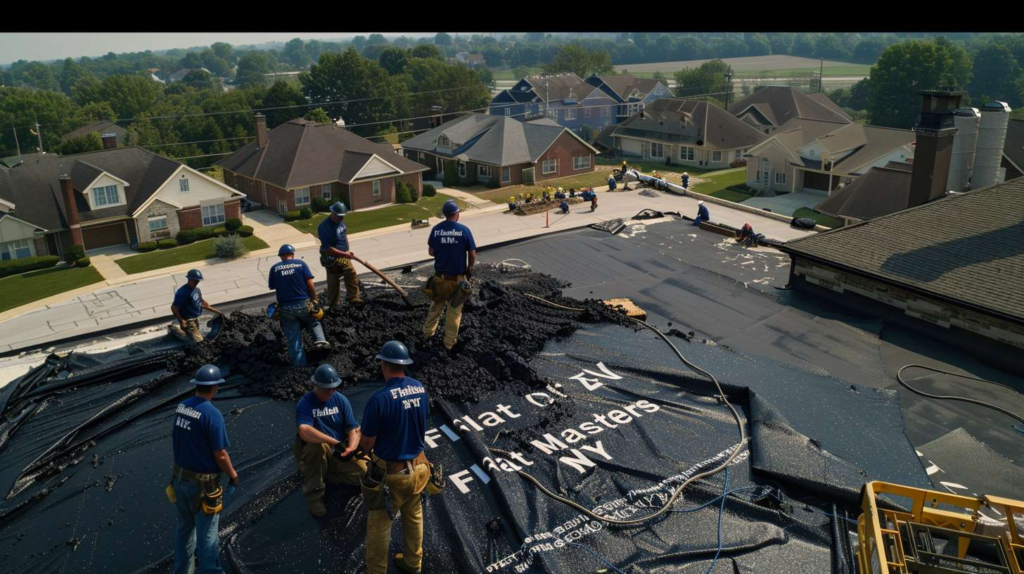
The shortcut that ruins orders is combining everything into one area total and hoping a calculator sorts it out on the back end. It won't. A flat roofing calculator only works cleanly when the inputs are already separated - and honestly, guessing waste from memory is lazy math that the calculator deserves better than. Queens rowhouses and mixed-use buildings, especially the attached homes and converted storefronts you find from Jackson Heights up through Flushing, often hide extra parapet returns, equipment curbs, and wall wraps that a single square-foot number will never capture.
The Exact Measuring Sequence Before Using a Flat Roof Material Calculator
-
1
Sketch the roof from above
Draw a bird's-eye view of the entire roof surface, even if it's rough. This single sketch becomes your anchor for every measurement that follows. -
2
Divide it into rectangles and smaller sections
Break the sketch into the simplest shapes possible. Every L-shape, bump-out, or offset gets its own box on paper before it becomes a number in the calculator. -
3
Label every height change and wall edge
Mark parapet walls, bulkheads, and any point where the roof steps up or down. These transitions drive flashing and base-sheet requirements that area alone won't show. -
4
Measure penetrations and curbs separately
Count every vent pipe, skylight curb, HVAC unit base, and drain sump as its own item. These each affect membrane cuts, flashing linear footage, and overall waste differently. -
5
Total each compartment before entering numbers
Add up each section on its own before a single digit goes into the calculator. Combining too early is where the order quietly falls apart.
What Belongs in Each Lunch-Tray Compartment
- 📐
Main roof field - The primary flat surface area, measured in square feet by section. This is your largest number and the first one recorded.
- 📏
Perimeter and parapet edges - The total linear footage of all wall-to-roof connections, parapet faces, and roof edges that require base flashing or edge metal.
- 🔩
Penetrations - Each vent pipe, skylight, and HVAC curb counted individually, with perimeter dimensions noted for flashing and membrane boot sizing.
- 🔗
Seam and overlap allowances - The additional membrane needed wherever rolls lap over each other, typically 3 to 6 inches per seam depending on the system specified.
- ✂️
Waste for cuts and irregular shapes - The percentage added to cover cuts around obstacles, trim conditions, and any roof geometry that doesn't divide evenly into roll widths.
Map every measurement the material order actually depends on
Field area is only one line on the list
Nineteen years in Queens has taught me this: the little wall edges eat your budget, not the open field. Calculating materials needed for a flat roof means collecting both square footage and linear footage - and here's the thing, most people skip the second category entirely. I'm Marisol Vega, and with 19 years of flat roofing experience in Queens and a specialty in correcting takeoffs on irregular flat roofs, I can tell you that the difference between a clean order and a shortage almost always lives in the linear measurements people forget to write down.
Linear footage quietly changes the order
Beyond the main field, a complete takeoff needs parapet wall heights and lengths, base flashing height at every wall, curb wrap dimensions, drain sump allowances, seam spacing, insulation layer count, and cover board specifications where the system calls for them. Each one of those items draws from a different material. Ignore one, and you're short on something the day the truck shows up - and not slightly short, short in the kind of way that stops a job cold.
Queens makes this harder than most places. Attached homes in Ridgewood sit so tight together that the shared wall returns get missed because nobody walked the party-wall side. Mixed-height buildings in Astoria have rooftop level changes that separate out into distinct measurement zones. Older commercial buildings in Sunnyside, particularly along Skillman Avenue, carry decades of equipment additions that create curbs and platforms no original blueprint ever showed. Every rooftop equipment piece and every elevation change needs its own line on the sketch - not one combined total.
Measurement Inputs for a Flat Roof Material Calculator
| Input to Collect | Unit | Where to Measure | Materials Affected |
|---|---|---|---|
| Field area (each section) | Square feet | Every distinct flat surface, measured separately | Membrane, insulation boards, cover boards |
| Parapet wall height and length | Linear feet | All four sides, each wall face measured individually | Base flashing, membrane, coping details |
| Penetration perimeters | Linear feet per unit | Around each vent, pipe, skylight, and HVAC curb | Flashing, pipe boots, membrane cut allowance |
| Drain and sump locations | Count + diameter | Every interior drain location on the roof plan | Drain flashing collars, membrane taper allowance |
| Seam spacing and layout | Linear feet | Planned roll direction across each roof section | Membrane overage, seam tape or torch allowance |
| Insulation layer count and board size | Square feet + layer | Full field area for each required insulation layer | ISO boards, cover boards, fastener count |
| Roof-level elevation changes | Count + linear feet | Every step-up, bulkhead base, and split-level transition | Step flashing, additional base sheet, counter flashing |
Test your totals against the materials you plan to install
Here's the blunt version: square footage alone is not a material list. Membrane comes in rolls of specific widths and lengths, insulation comes in boards with fixed dimensions, and flashing is ordered by the linear foot - so your takeoff has to be translated into purchasable units, not just a grand total of square feet. That gets you close, but not close enough. Do your numbers match how the materials are actually sold?
⚠ Warning: Ordering Directly from Area Only
Relying on one big square-foot number causes shortages in membrane, flashing, and insulation - especially on flat roofs with parapets, bulkheads, and equipment curbs. On a chopped-up Queens rooftop, that single number can be off by enough to stop a job mid-install. The shortage won't be obvious until the last roll is already laid and the wall edges are still bare.
Run a practical calculator check for waste, seams, and awkward details
Waste is not guesswork on an irregular roof
I once watched a man lose half a day over twelve missing feet of membrane. It was a muggy August morning in Ridgewood, maybe 7:15, when a landlord handed me numbers his super had scribbled on the back of a deli receipt. He had measured the main field and ignored the two parapet returns and the vent curb wraps - and he was short by just enough to ruin the whole day. That was the morning I started telling people, "If your roof has corners, your calculator needs manners." Waste is not a flat percentage you pull from memory. It depends on roof shape, the direction you're laying rolls, how many obstacles force cuts, and how complex the trim conditions are at edges and penetrations.
The insider move is to run the calculator twice. First pass: clean geometry only, nothing added, just the pure field and edge measurements. Second pass: add seam allowances, starter piece requirements, curb wraps, trim conditions, and any awkward cut zones. The gap between those two numbers tells you exactly where the shortage risk lives - and that's worth knowing before the delivery truck parks outside. With single-ply systems and modified bitumen alike, the second pass almost always moves the number more than people expect.
Common Flat Roofing Calculator Mistakes
| Myth | Real Answer |
|---|---|
| "The calculator knows my waste automatically." | No calculator knows your roof shape, roll direction, or cut complexity. You have to input a waste percentage based on your specific conditions - a simple square roof might need 5-8%, an irregular one with obstacles can need 12-15% or more. |
| "A parapet wall is already included in my roof area." | Roof area measures the flat deck surface only. Parapet walls add their own linear footage requirement for base flashing and membrane wrap - often several hundred feet on a mid-size commercial building - and that material is completely separate from the field calculation. |
| "One roof level means one measurement." | Even a single-level roof can have setback sections, raised curbs, and tapered insulation zones that each require their own inputs. One number for one level is only true on the simplest rectangle with zero obstacles. |
| "Vent curbs barely affect material count." | A single HVAC curb can require 3-5 feet of membrane in each direction for proper flashing and overlap, plus separate flashing material for the curb wrap itself. Multiply that by four or five units on a commercial rooftop and it changes the order meaningfully. |
| "All flat roof systems use the same overlap assumptions." | Overlap requirements vary by membrane system and manufacturer. A TPO installation may call for a 6-inch seam while a modified bitumen base sheet uses a different overlap at laps and end joints. The overlap assumption must match the specific system being installed. |
Quick Clarifications on Calculator Inputs and Overages
Verify the order before delivery day in Queens
If I asked you where the roof changes height, could you point to every spot without squinting? One February afternoon in Astoria, I was standing on a pale gray modified bitumen roof with sleet tapping my hood, helping a young couple price a replacement before closing on the house. Their uncle had "calculated" materials by square footage alone - no waste, no flashing, no seam allowance, nothing for the base sheet overlap. I drew boxes with a carpenter pencil on the frosty surface and showed them exactly why a roof is never just one number. The base sheet overlap alone added two full rolls to the order. The flashing added another line that hadn't existed anywhere in the uncle's estimate. And none of that showed up in area.
I had a bakery owner in Sunnyside call me at 5:40 in the evening because his supplier had dropped off half the insulation order and insisted the takeoff was correct. I climbed up while the exhaust fans were still blowing out warm bread smell and found three elevation changes hidden behind rooftop equipment - each one its own zone, each one requiring separate flashing and its own insulation count. I still remember telling him, with cinnamon in the air, that roofs lie politely until you measure every level separately. If any level, curb, or wall wrap is still fuzzy on paper when you're looking at this, the material order isn't ready yet. The sketch has to be complete and honest before anyone calls in the numbers - and if you're in Queens and that last check still feels uncertain, Flat Masters can walk through the takeoff with you before the truck shows up.
Before You Ask for a Flat Roof Material Takeoff in Queens, NY
-
✓
Roof sketch completed from above, with every section drawn out -
✓
Each section measured separately, not combined into one total -
✓
Parapet wall heights and lengths noted per wall face -
✓
All penetrations counted and sized - vents, skylights, HVAC curbs, drains -
✓
All roof-level changes identified and marked on the sketch -
✓
Material system chosen or narrowed down - membrane type, insulation spec, flashing system
Field Area
Measured in square feet, section by section - never combined until every compartment is individually confirmed.
Edge & Flashing Footage
Total linear feet of all parapet walls, wall edges, base flashing runs, and step transitions on the roof.
Penetrations & Curbs
Every vent, skylight, drain, and HVAC base counted individually, with perimeter dimensions noted for flashing quantities.
Waste & Overlap Allowances
Calculated per section based on roof geometry, roll layout, seam spacing, and cut complexity - not a universal guess.
A complete sketch with every compartment filled in is what separates a clean delivery from a mid-job phone call. If the numbers are done and the order still doesn't feel solid, Flat Masters can review the takeoff with you before anything gets delivered to your Queens rooftop.