
Sheet Materials for Flat Roofs - Here's Which One to Actually Choose for Your Job
Loose. Most people walk into a roofing conversation asking for a membrane by name - "just give me TPO" or "my neighbor used modified bitumen" - when the smarter move is matching flat roof sheet materials to the building's actual edges, traffic patterns, and drainage problems. That name-first approach is how people end up with the wrong sheet on the right building, and then spend the next three years wondering why it keeps leaking at the same corner.
Forget Brand Names and Read the Roof First
A roof membrane is a lot like an old diner sign face - and I'd know, because I spent years restoring those with my uncle in Corona before I ever picked up a membrane roller. The materials tell on themselves. You walk a flat roof and the wrinkles, seam lines, soft spots, and wear patterns are reading out loud if you know what to listen for. A blister in the middle of a field isn't a product complaint; it's the substrate talking. A seam that's curling near a parapet isn't random; it's geometry and edge detail leaving evidence.
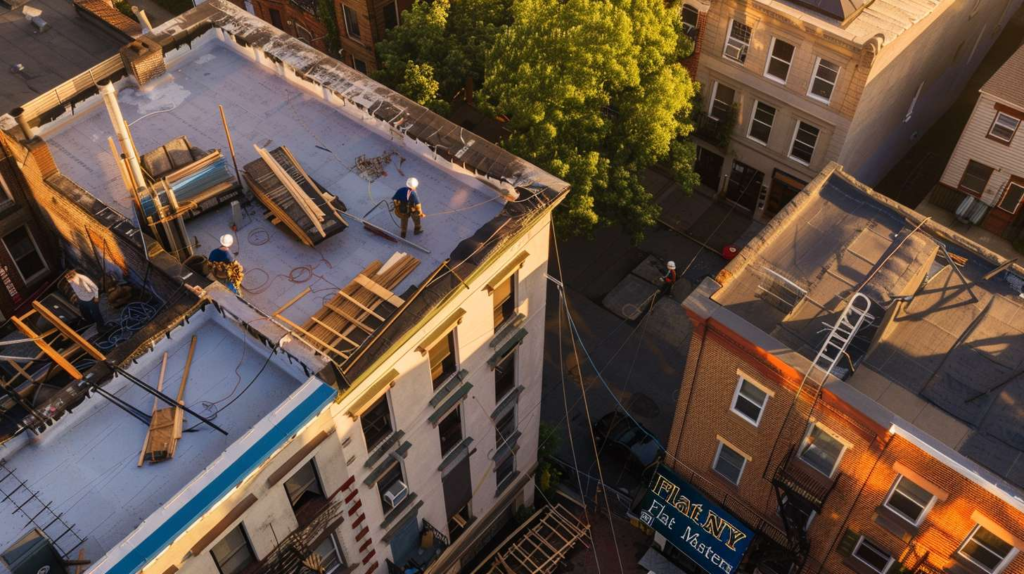
Here's my plain opinion: asking for a membrane by name before you've looked at drainage and edge conditions is how people waste money. Not a little money - a lot of it, over multiple repair calls. No single sheet wins every job. What actually decides the answer is the building's layout, how it drains, who walks on it, and what it's attached to. This guide sorts through the common roofing sheets for flat roof work the way I sort them on a Queens job site - by conditions, not catalog pages.
Match Common Sheet Options to the Kind of Roof You Actually Have
TPO for Cleaner Layouts and Heat-Reflective Goals
EPDM When Simplicity Helps and Seams Are Planned Well
Modified Bitumen for Abuse-Prone Surfaces and Complicated Tie-ins
Seventeen years in Queens taught me this: the roof geometry changes the answer faster than any spec sheet will. I'm Rene Valdez, and I've spent most of my career sorting out which roofing sheets for flat roof jobs actually hold on the weird stuff - rowhouse rear additions, mixed-use second floors above restaurants on Jamaica Avenue, low-slope garage tops attached to three-family buildings. The clean, rectangular roof is almost never what I'm standing on. Odd angles, stacked parapets, offset drains - that's Queens. And that geometry is what forces a real material conversation.
At 6:40 one morning in Ridgewood, coffee still too hot to drink, a building owner pointed at his "new" modified bitumen roof and asked why it already looked worn out. The sun had just hit the surface at a low angle, and I could see the sheet lines telegraphing right through - the install crew had rushed the substrate, and the irregularities underneath were printing themselves onto the surface above. The low spots were still holding dew at that hour. Now, before you blame the material - modified bitumen didn't fail that roof. Poor substrate prep and sloppy drainage planning did. The membrane just told on it. That's the thing about flat roof sheet materials: they're honest about what's underneath them, whether you want them to be or not.
Here's the plain comparison. TPO earns its keep on cleaner, more regular roofs - heat-weldable seams, decent reflectivity for Queens summers, and it's generally easier to install on straightforward layouts. It can disappoint when the detailing gets complicated, because the seams demand clean execution and the material doesn't forgive a rushed parapet flash. EPDM is durable and flexible - great on simpler roofs and cold-weather movement - but the adhesive seams require real care, and poorly done EPDM laps are how a lot of callbacks start. Modified bitumen is the heavy-use, detail-heavy answer. It handles abuse, it layers well at complicated tie-ins, and it's been proven across decades on exactly the kind of multi-story rowhouse and mixed-use buildings that Queens is full of. The install is more physical, and it's less forgiving of a crew cutting corners on prep - but on a roof with real geometric complexity, it often wins the long game.
| Material | Typical Strength | Weak Spot | Best Building Fit | Edge/Detail Difficulty | Foot Traffic Tolerance | Queens-Specific Watchout |
|---|---|---|---|---|---|---|
| TPO | Heat-reflective, UV resistant, clean seam welds | Seam quality drops fast with rushed crews | Simple, regular rooflines; commercial flat decks | Medium - requires careful flashing at walls | Low-moderate; not built for regular abuse | Rowhouse parapets can stress thin TPO at tie-in points |
| EPDM | Flexibility in cold temps, long track record | Adhesive lap seams are a callback risk if sloppy | Simple residential flat roofs; low-traffic surfaces | Low-medium - simpler detailing but seam-sensitive | Low; punctures show up quickly | Black surface absorbs summer heat - worth considering in south-facing Queens rooftops |
| PVC | Chemical/grease resistant, strong welds, reflective | Higher material cost; can get brittle in extreme cold over time | Restaurant/bakery roofs, mixed-use, chemical exposure | Medium - heat welds well but requires experienced installer | Moderate; better than TPO for light foot use | Best answer for Jackson Heights and Flushing mixed-use rear extensions with grease vents |
| Mod Bit | Durable, handles complex geometry, proven in layers | Substrate prep and installation quality are everything | Rowhouses, multi-family, heavy parapet detail jobs | High complexity - but rewards a skilled crew well | High; built for service access and real-world abuse | Telegraphs bad substrate fast - Ridgewood rowhouses often show this within one season |
| Myth | Real Answer |
|---|---|
| White membrane always lasts longer | Color has nothing to do with lifespan. White TPO and PVC reflect heat, but a poorly detailed white membrane will fail faster than a well-installed dark one. |
| Thicker automatically means better roof | Thickness helps with puncture resistance, but a thick membrane over a wet or uneven substrate is still a problem waiting to show itself. |
| Ponding water is normal on any flat roof | Standing water beyond 48 hours is a drainage and slope problem. No membrane is designed to handle chronic ponding - it accelerates wear at seams and edges regardless of material. |
| A new membrane fixes a bad deck | It doesn't. A damaged or uneven deck telegraphs through any sheet material. The substrate has to be right before anything goes on top of it. |
| Cheapest sheet is fine if selling soon | A failed roof shows up in inspections, kills deals, and sometimes costs more to fix under pressure than doing it right the first time. "Selling soon" is not a roofing strategy. |
Spot the Conditions That Change the Recommendation Fast
One August afternoon in Jackson Heights - sticky enough to make you feel like you were working inside a steamed-up mirror - I was inspecting a rear extension roof above a bakery. The tenant downstairs was convinced the roof was melting because she kept catching a faint vanilla-and-something-chemical smell drifting up through the ceiling. It wasn't melting. It was a cheap sheet membrane reacting around a vent detail where years of grease and heat exhaust had been working on it quietly. The material didn't cause the problem; the vent detailing and membrane selection for that exposure caused the problem. That's exactly what happens on Queens mixed-use buildings, rear additions over commercial kitchens, service doors on second-floor restaurant roofs - the conditions are specific, and a generic membrane answer misses them entirely. I left that job with a muffin because the baker insisted, and I left her with a straight answer about which roofing sheets for flat roof situations like hers actually hold up near exhaust sources.
That sounds like a membrane problem, but it usually isn't - it's a conditions problem that the membrane gets blamed for. Before you price anything, there are three questions worth asking on any Queens flat roof: Who goes up there, and how often? What do the drains collect - leaf debris, grease residue, HVAC condensate? And do those parapets and copings move seasonally? Brick parapets on older rowhouses shift with freeze-thaw cycles, and if the flashing detail doesn't account for that movement, the seam at the wall tie-in will tell on it within two winters, regardless of what sheet is below.
-
🍳
Grease exhaust nearby: Vent stacks or commercial kitchen exhausts pointing at the membrane mean PVC should be your starting conversation, not TPO. -
💧
Chronic ponding: Visible staining rings on the existing surface mean slope correction has to happen before any material decision does. -
👷
Frequent foot traffic: HVAC service, rooftop access, equipment checks - anything more than twice a year calls for puncture-rated or reinforced sheet. -
🧱
Heavy parapet perimeter: Lots of wall tie-ins mean detailing complexity goes up fast - modified bitumen handles this better than thin single-ply on rowhouse geometry. -
🔩
Multiple penetrations: Drains, vents, stacks, conduit - more than four penetrations on a small roof means the field membrane matters less than how each boot is detailed. -
📐
Old uneven substrate telegraphing through: Ripples and bumps visible on existing membrane mean strip and re-deck before new material goes down - or the problem ships forward.
Before You Choose a Membrane - Check This First
Installing new flat roof sheet materials over low spots, damp insulation, unstable deck sections, or poorly finished edge conditions sets up early seam stress, surface fatigue, and leak callbacks that will be blamed on the material - and shouldn't be. No sheet material should be used as a cover-up for structural issues, slope defects, or wet insulation. If the substrate isn't right, the best membrane in the catalog still fails early. Fix the base, then choose the sheet.
Use This Short Filter Before You Commit to a Material
What do I ask before I even price it? Blunt truth: not every flat roof deserves the same sheet. The material conversation should come after you've walked the drainage, checked the substrate, counted the penetrations, and asked who uses that roof and why. Skipping that step and jumping to product selection is like ordering a custom suit before you've been measured - it might fit, it might not, and you won't know until it's already on.
If the roof edge is wrong, the membrane never gets a fair trial.
- Roof age: How old is the current surface, and do you know what's under it?
- Known ponding areas: Does water sit anywhere on the roof after a storm, and for how long?
- Who walks on it: HVAC techs, cable installers, tenants, or nobody - and how frequently?
- Number of penetrations: Count the drains, stacks, vents, conduit, and any equipment bases.
- Restaurant or grease exposure: Is there a commercial kitchen, bakery, or food service space below or adjacent?
- Parapet and coping condition: Are brick parapets cracked, are copings loose, or is there visible separation at the flashing base?
- Where leaks enter: Do they appear at field seams, at wall tie-ins, or around penetrations? That location changes everything.
Clear Answers for Owners Stuck Between Two or Three Options
During a windy Saturday in Ozone Park - the kind where the gusts come off 101st Avenue in short, sharp bursts - I was doing an inspection for an owner who had decided he wanted the thinnest, cheapest sheet because he was listing the house in spring. Mid-inspection, a loose corner at the parapet snapped up and slapped the coping hard enough to make his teenage son flinch. I looked at the owner and said, "That sound is future paperwork." And honestly, that was the whole conversation. A buyer's inspector hears that same corner on a cold morning, and the deal slows down or dies. Cheap and thin doesn't disappear at closing - it follows you into negotiation. The membrane you install now is the one that shows up in the inspection report, and it tells on itself just like everything else.
| Factor | Same Material - Pros | Same Material - Cons | Switch Material - Pros | Switch Material - Cons |
|---|---|---|---|---|
| Detailing Familiarity | Crew knows existing flashing profiles; fewer surprises at tie-ins | Repeats any poor detailing habits from the previous install | Fresh approach can correct chronic failure points | New material requires different tools and techniques - crew experience matters |
| Compatibility | No compatibility issues with existing flashing materials | If the original spec was wrong for this roof, you're repeating the mistake | Opportunity to match material to actual current building conditions | Must verify compatibility with existing substrate and any remaining layers |
| Cost Surprises | Typically easier to estimate; known scope | Same performance issues will likely recur if root cause isn't fixed | May reduce long-term repair frequency | Additional substrate prep or deck work may be needed to support new system |
| Performance Gain | Predictable outcome if original material was appropriate | No improvement if original material was a poor match for conditions | Real performance gain when driven by conditions, not just preference | Only delivers gain if the switch is based on an honest site assessment - not a sales pitch |
Sorting through flat roof sheet materials without guessing takes a site walk, honest questions, and someone who's seen enough Queens roofs to know what the building is actually asking for. If you want a straight recommendation - no pressure, no product pitch - call Flat Masters and let's look at your roof together. We're in Queens, we know Queens buildings, and we'll tell you exactly what we'd put on it and why.