
Cracks on a Flat Roof Surface Are a Warning Sign - Here's What They Mean
Let's agree on one thing, small surface cracks on a flat roof often matter more than a dramatic ceiling stain - because the membrane starts losing integrity well before water ever reaches the space below. The goal here isn't to alarm you; it's to help you read what the roof is already showing you, early enough to avoid a repair that costs three times as much.
Why Hairline Damage Deserves Attention Before a Leak Does
A ceiling stain gets everyone's attention. It's visible, it's disruptive, and it's hard to ignore. But by the time that stain appears, the flat roof surface cracking above it has usually been building for months - sometimes longer. The membrane doesn't fail the moment water shows up inside. It fails gradually, through stress cycles, lost flexibility, and moisture that migrates slowly through layers you can't see from the ground floor.
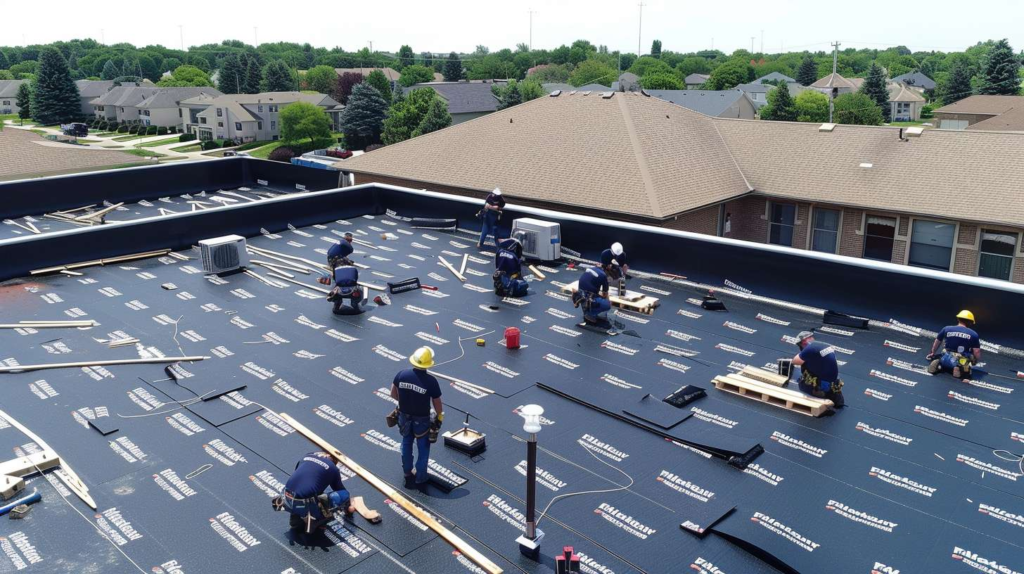
At 8 a.m. on a Queens roof, the cracks tell the truth faster than the customer does. I remember being on a six-family building in Elmhurst at 7:15 in the morning after a cold snap, and the super kept insisting the roof was "just aging normally." The sun had barely hit the surface, and those hairline cracks looked tiny until I pressed one with my glove and the membrane opened like dry skin. By noon, once the roof warmed up, they were less obvious - and that's exactly why owners misread them. I'm Rosa Mendel, and in 22 years of flat roofing across Queens, my specialty has been tracking exactly these kinds of mystery crack patterns that other crews shrug off and walk away from. When I document a crack layout on a building, I treat it the way I'd treat evidence on a diagram - the position, the direction, the clustering - none of it is random wear.
| Myth | What It Actually Means |
|---|---|
| "If it's not leaking inside, it's harmless." | Hidden membrane stress can exist long before water reaches interior space. By the time you see a stain, the system has usually been compromised at the surface level for a while. |
| "Hairline cracks are just normal aging." | Some surface checking is expected over time - but hairline cracks that cluster, branch, or appear near seams and flashings are often early signals of a membrane losing its flexibility faster than it should. |
| "Coating over cracks fixes the problem." | A reflective or elastomeric coating applied over active cracking doesn't address what's underneath. It can temporarily seal the surface while trapping moisture and masking movement that needs proper diagnosis first. |
| "Cracks only matter around seams." | Field-area cracking - cracking in the open, flat sections away from seams - is just as significant. It often signals substrate movement, thermal stress, or membrane shrinkage across a larger area than you'd expect. |
| "Warm weather means the issue has gone away." | Thermal expansion can make cracks appear to close or become less visible on a warm afternoon. That's not healing - it's the roof material responding to heat. The crack is still there; you just can't see it as clearly. |
Reading the Pattern: What Different Crack Shapes Usually Point To
Here's my unpopular opinion: a flat roof almost never "suddenly" fails. What looks sudden from the inside - a water stain appearing after a rainstorm - usually has months of surface evidence that went unread up top. And the shape of that evidence matters as much as the size of it. In Queens, where freeze-thaw swings can be brutal from January through March, rooftop HVAC and mechanical equipment adds vibration stress, and older parapet-heavy buildings in neighborhoods like Ridgewood and Astoria bake under direct sun exposure for hours - the crack pattern on a flat roof is a compressed record of everything that building has been through.
A roof surface behaves a lot like the dried riverbeds I used to show my students - stress leaves a pattern before it leaves a collapse. Alligator cracking, that multi-directional webbing that looks like reptile scales, usually tells me the membrane has lost elasticity over a broad area and is no longer moving with the structure beneath it. A single long split running parallel to an edge or parapet often signals differential movement - the deck shifting slightly at a different rate than the membrane above it. Branching crack lines that radiate outward from a central point tend to show up near old patch edges, where two materials with different flexibility rates have been fighting each other through seasons. Each of these is a clue, not a coincidence.
I once watched a tiny surface split in Sunnyside turn into a full repair job by the next season. It started as maybe an eight-inch crack near a drainpipe - nothing dramatic. But that spot sat in a low area where water ponded after every rain, the summer heat softened the membrane right at the patch edge, and by fall the crack had opened wide enough to let water work beneath the field seam. Honestly, the owner had been told by someone else that it was "just cosmetic." Rosa's dry opinion on that: when you can see the stress lines, the cosmetic window has already closed.
| What You See | Likely Cause | What It Tells Us | Recommended Response Window |
|---|---|---|---|
| Hairline webbing in coating layer | UV degradation, coating age, thermal cycling | Surface-level stress; membrane may still be intact beneath | Schedule professional evaluation within 60-90 days |
| Alligator cracking near old patch | Material incompatibility, patch edge movement, lost flexibility | Membrane no longer moving as a system; high risk of water infiltration | Inspection within 2 weeks; likely repair or restoration |
| Single long split at parapet area | Differential movement between deck and wall structure | Structural stress transferred to membrane; parapet flashing may be compromised | Urgent - inspect within days, especially before rain |
| Branching cracks near ponding zone | Repeated water weight, drainage failure, freeze-thaw pressure | Substrate likely softened or damaged; cracks will expand with next moisture cycle | Urgent - address drainage and membrane together |
| Circular cracking around penetration flashing | Flashing separation, pipe movement, failed sealant | High-probability water entry point; flashing system needs full re-evaluation | Inspect immediately - this is a known leak pathway |
Clues Around the Crack Matter as Much as the Crack Itself
If I asked you where the water sits after a storm, could you point to it without guessing? That question matters more than most owners expect. A crack sitting in a dry, elevated section of membrane behaves differently than one in an area where water routinely ponds for 48 hours after rain. The context around a crack - soft spots underfoot, blistering nearby, the edge of an old patch, a parapet wall that shows stress at the base - all of that changes what the crack means and how fast it can turn into a real problem. During a windy evening inspection in Astoria, a co-op board member walked me up to the roof with a flashlight from her phone because the building hatch lights weren't working. Near the parapet on the Roosevelt Avenue side, I found a long split branching out from a cluster of smaller surface cracks, all starting exactly where ponding water had been sitting after storms. The board had been budgeting for brickwork, not roofing - and you could see the mood in the room shift when I showed them how that crack line followed the stress points almost like a fault line on a map. The crack wasn't the whole story. The ponding zone, the parapet base, and the patch history were the chapters around it.
A crack line is almost always the visible surface of a larger movement problem happening underneath it.
Any softness underfoot, ponding history, old patch nearby, edge detail stress, or seam within a few feet?
Are cracks repeated in clusters, alligator-like in pattern, or extending from a parapet, drain, or penetration?
Practical Next Moves for a Queens Property Owner
What to Document Before You Call
Bluntly, cracks are the roof's way of saying the system is losing flexibility - and the more you can document before calling a roofer, the faster and more accurately they can assess what you're dealing with. Photograph crack locations from a wide shot and close-up, note where you see softness underfoot, and mark any areas where water was sitting after the last rain. One August afternoon in Ridgewood, I was called by a bakery owner who only wanted me to check a ceiling stain over the prep area. It was 93 degrees, the roof was soft underfoot near the drain, and the cracking near an old patch had that alligator pattern I never like to see. He mentioned another contractor had coated over it the year before - which is a bit like putting makeup on a sprained ankle and calling it healed. That coat didn't preserve the membrane; it just hid the problem long enough for it to get worse. Don't touch the cracks, don't apply any product, and don't assume the coating will hold through the fall season.
When Repair Can Wait and When It Should Not
Now look at what that tells us: not every crack is an emergency, but the line between "monitor it" and "call today" is narrower than most owners expect. If cracks are isolated to a dry surface area, no ponding nearby, no softness underfoot, no spread since you last checked, and there's no interior moisture - you can schedule a professional evaluation without panic. But if you're seeing widening, cracking at the parapet or around a drain, active blistering, or any pattern that follows a stress line, that's the threshold. Don't wait for the next rain to confirm what the surface is already showing. Here's an insider tip worth keeping: photograph the same crack zone early in the morning and again late in the afternoon on a warm day. The width and visibility can shift enough that you'll have two different-looking photos - and both are telling the truth about a membrane that's no longer stable.
Cracks are evidence - and ignoring evidence doesn't make a problem smaller, it just makes the repair bigger. If you're seeing flat roof surface cracking on your Queens building and want an honest read on what it's telling you, call Flat Masters and let us take a look before a surface issue turns into a structural repair.