
Felting a Flat Roof Is a Skilled Job - Here's What a Proper Service Delivers
One approach extends the problem. The other ends it. Flat roof felting looks straightforward from the street - unroll the material, apply heat or adhesive, done - but the failures that bring homeowners and building owners to us at Flat Masters almost never start where the water shows up. They start at an edge that wasn't restrained properly, a seam that was lapped short, a drain that nobody reviewed before the layers went down. This article shows exactly what a proper felt flat roof service delivers in Queens, NY, and why the difference between a roof that lasts and one that fails inside two seasons has nothing to do with how smooth it looks on day one.
Why Simple-Looking Felt Work Fails So Often
One approach extends the problem. The other ends it. Flat roof felting looks deceptively simple from the ground - roll it out, bond it down, trim the edges. But every failure I've been called to diagnose, from Jamaica to Woodside and across the whole western stretch of Queens, has traced back to one or two small installation details that were handled by someone who didn't understand how a roof actually moves, breathes, and sheds water under real-world conditions. The work looks finished. It just isn't sound.
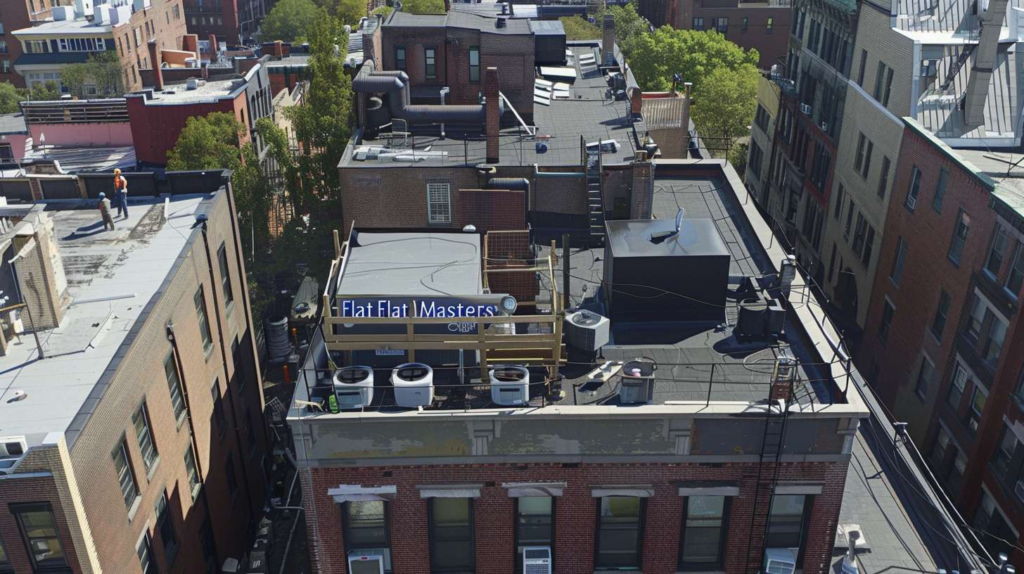
At the roof edge, that's where I start. That's where water pressure concentrates, where thermal expansion pulls at the material, and where a poorly terminated lap will begin drawing moisture inward before the first hard rain is even over - and that is usually visible long before the leak reaches a ceiling, as Marta Zielińska, with 27 years in flat roofing and a specialty in diagnosing failed felt systems, has seen again and again. Edge failure triggers water entry. Water entry under a bonded layer creates a trapped pocket. That pocket expands with heat, lifts the surface, weakens adhesion at the nearest seam, and from there the chain moves fast. What looked like a smooth, completed roof in October is blistering and splitting by the following July.
| Myth | Real Answer |
|---|---|
| "Felt is just a cheap temporary layer." | A properly installed felt system is a sequenced, multi-layer weatherproof assembly. The material grade matters, but substrate prep and lap sequencing determine whether it performs for 10 years or 2. |
| "If it looks smooth, it was installed right." | A smooth surface tells you nothing about lap alignment, edge restraint, or what's happening beneath the top layer. Trapped moisture and short laps are completely invisible until the system reacts to heat or rain. |
| "A patch fixes bubbling." | Bubbling signals trapped moisture below the membrane. Patching the surface without removing the cause traps that moisture further and accelerates delamination of the surrounding area. |
| "Any roofer can felt a flat roof." | Felt flat roof installation requires specific knowledge of substrate behavior, thermal movement, drainage falls, and upstand detailing. A crew experienced only in pitched shingling will miss the critical details every time. |
| "Leaks always start at the obvious wet spot." | Water travels under bonded layers and along structural elements before it drops. The ceiling stain in a Queens row house bedroom may be coming from a parapet seam or vent tie-in ten feet away. |
⚠️ Warning: Felting Over Damp Substrate
When a crew lays felt over a substrate that hasn't been properly dried or tested for trapped moisture, here's exactly what happens: the moisture below the sealed membrane heats up with the sun, expands, and has nowhere to go. It pushes upward, forming bubbles that weaken adhesion across the entire bonded area. Weakened adhesion means seams lift. Lifted seams mean open water pathways. Open water pathways mean interior leaks - often appearing weeks or months after the job was signed off as complete.
Don't judge workmanship by how a roof looks on day one. Judge it by who checked what was underneath before a single roll was laid.
What a Proper Felting Service Actually Includes
Here's the part people never enjoy hearing. Professional felting services cost more than a rushed layer job because the majority of the work that keeps a roof sound happens before the felt ever touches the surface. Queens roofs aren't straightforward - parapet walls with cracked cappings, old surfaces with two or three generations of mixed repairs, drains half-blocked by tree debris from the maples along the residential streets, and the kind of ponding that builds up fast after a hard summer storm rolls through. All of that has to be read and addressed before any material goes down, or you're just sealing problems in.
Preparation Before Any Felt Is Rolled Out
The sequence matters more than the speed. A proper service begins with a full roof inspection - not a glance from the hatch, but a systematic review of the deck, existing surface condition, drainage falls, and every penetration. Substrate evaluation tells you whether you're working over a sound base or inheriting someone else's compounding failure. A moisture check - done properly with a probe or capacitance meter rather than a visual guess - identifies wet zones that must be addressed before any bonding can hold. Drains get reviewed for blockage and for whether the fall toward them is still functional. And then layout is planned: where the laps run, how upstands will be dressed, which penetrations need independent detailing before the field is even started.
Detailing That Protects Seams, Corners, and Penetrations
Think of it as a simple experiment: one bad seam leads to trapped moisture, trapped moisture leads to blistering, blistering leads to early failure. That's not a theory - I watched it play out on a November afternoon in Ridgewood, with that damp cold that gets into your hands, when I was called to a bakery where the owner said his leak only appeared when wind pushed rain sideways. The previous crew had done what they called professional felting services, but they'd left weak detailing around a vent stack and tied the felt poorly at the upstand. We stood under the exhaust fan listening to the drip hit a metal prep table, and I told him: "This is not a mystery. This is sequencing done badly." Every seam, corner, pipe collar, and parapet tie-in is a potential entry point - and every one of them deserves deliberate, unhurried detailing.
What Should Be Included in Any Flat Roof Felting Service
- ✅ Moisture assessment - probe or meter test of the existing substrate before any layers are laid
- ✅ Substrate preparation - removal of failed material and repair of any deck defects
- ✅ Drain check - clearance, fall verification, and collar condition review at every outlet
- ✅ Edge detail work - proper termination at all perimeter edges and parapet walls
- ✅ Vent and pipe detailing - independent collaring or soaker at each penetration
- ✅ Lap alignment - correct overlap widths run in the right direction relative to drainage falls
- ✅ Finish inspection - seam-by-seam check with documented findings before handover
- ✅ Cleanup and documented findings - site left clear, with a written record of what was found and addressed
| Service Area | Proper Felting Service | Shortcut Installation |
|---|---|---|
| Inspection time | Full survey of deck, falls, drainage, and existing layers before any material is priced or ordered | Quick visual from the hatch; measurements taken, quote given in minutes |
| Substrate prep | Failed or compromised material removed; deck repaired; surface cleaned and primed where needed | New felt rolled directly over existing surface regardless of condition |
| Existing moisture treatment | Identified with a moisture meter, wet zones isolated and dried or removed before installation | Not tested; moisture sealed under the new layer, leading to future blistering |
| Edge details | Planned before the roll starts; felt terminated with correct restraint at every perimeter point | Trimmed at the edge and stuck down; no independent restraint or consideration of thermal movement |
| Penetration details | Each vent, pipe, and stack collared or soakered individually before field felt is laid | Main felt run to the penetration and mastic applied; collar detailing skipped or minimal |
| Drainage review | Falls confirmed before laying, drains cleared and collared, ponding risk points addressed | Drains left as-found; no fall verification; ponding areas covered over |
| Expected lifespan implications | 10-20 years of functional performance when maintained, with failure points minimized from day one | Early bubbling, seam splits, and leak callbacks typically within 1-3 seasons |
How Queens Roofs Reveal Bad Work Before the Big Leak
I once stood on a roof in Elmhurst with frost still on the drain cover, looking at a felt surface that was less than eighteen months old and already showing raised patches the size of dinner plates. The homeowner thought it was age. It wasn't age - the roof hadn't earned the right to age yet. What I was looking at was the predictable result of a crew that rushed the install in late October without checking what was already trapped in the existing substrate. When the heat came back the following summer, that moisture expanded, pushed upward, and did exactly what physics requires. And honestly, this pattern isn't isolated to one street in Elmhurst. I'd seen the same signatures on jobs in Astoria - a July morning, about 6:40, sun barely starting to heat the black surface, homeowner already outside in slippers asking why his new flat roof felting had bubbles after just one season. I peeled back a section near the parapet and found a rushed layer job with trapped moisture underneath. That was one of those mornings where the roof told the truth before the contractor ever did. Western Queens has enough attached and semi-detached properties with aging parapets that this kind of cascading failure turns up more often than it should.
If you were standing next to me, I'd ask you one question first: is the water getting in because the system is genuinely at the end of its service life, or because it was assembled badly from the start? That answer changes everything - the remedy, the cost, and what you should actually expect going forward. Here's the insider tip that most people miss: compare where the interior stain appears against the roof layout. The stain almost never sits directly below the entry point. Water travels horizontally under bonded layers, along structural members, and through insulation before it drops. Walk the roof and look at edges, seam lines, vent collars, and parapets - not just the area above the wet ceiling. That's where the story actually starts.
A flat roof does not care whether the mistake was small; it only reacts to what water can use.
Earliest Clue
Edge lifting or tiny seam splits - usually visible at parapets or perimeter edges before any interior damage appears.
Misleading Symptom
A ceiling stain may appear several feet - sometimes an entire room - away from the actual water entry point on the roof.
Weather Trigger
Wind-driven rain is the fastest test of weak upstand detailing - a leak that only appears in sideways rain is almost always an upstand or parapet tie-in failure.
Common Hidden Cause
Moisture trapped below rushed layers - invisible at installation, revealed by the first hot summer when it expands and forces seams open from underneath.
Questions Worth Asking Before You Hire Anyone to Felt a Flat Roof
Let me be plain about this. I'm Marta Zielińska, and I've been doing flat roofing in Queens, NY for 27 years. I have little patience for crews who call a rushed layer job "good enough" when they skipped the details that actually keep water out - and I've seen the consequences that attitude leaves behind. One Sunday in Jackson Heights, I was called to an emergency after a father tried a do-it-yourself patch because a hardware store clerk told him roof felt was straightforward to apply. By 5 p.m. the patch had shifted, water had tracked under the lap, and his daughter's bedroom ceiling had stained in a perfect brown ring above her desk. I wasn't angry with him - I was angry that someone made flat roof felting sound like wrapping a package instead of building a weatherproof system. The questions below are what a knowledgeable contractor should be able to answer without hesitation. If they stumble on moisture testing, penetration detailing, or how they handle old patches, that tells you exactly what the roof will tell you six months later.
Before You Book Flat Roof Felting Services - Verify This First
- ✅ Ask whether they inspect edges and perimeter details before quoting - not after arrival
- ✅ Ask how they test for trapped moisture beneath the existing surface
- ✅ Ask exactly what substrate preparation is included in the quoted price
- ✅ Ask how penetrations - vents, pipes, stacks - are individually detailed
- ✅ Ask whether drains are cleared, inspected, and fall-checked before the first layer goes down
- ✅ Ask how existing patches or mixed-repair areas will be evaluated and treated
- ✅ Ask what final inspection points are documented and how findings are handed over to you
Common Questions About Felt Flat Roof Service in Queens
If you want flat roof felting services carried out as a weatherproof system - not a surface cover - call Flat Masters. We've been doing this work across Queens, NY long enough to know exactly where shortcuts come back to haunt a building, and we're not interested in being the crew you call to fix someone else's rushed job twice.