
What Does It Cost to Build a Flat Roof From Scratch? Here Are the Real Numbers

What Does It Cost to Build a Flat Roof From Scratch? Here Are the Real Numbers

What Does It Cost to Build a Flat Roof From Scratch? Here Are the Real Numbers

The gap between what you paid and what you got. That gap is usually where the confusion about flat roof construction cost lives - and in Queens, where roofs are older, access is tighter, and building assemblies hide surprises, that gap can be $8,000 wide before the first nail goes down. A flat roof built from scratch on a residential or mixed-use building here typically runs somewhere between $14,000 and $38,000+, depending on size, deck condition, insulation spec, drainage needs, and edge complexity. This article breaks down where that money actually goes, so you can read an estimate and know whether the math is honest.

Real Queens Price Bands for a Brand-New Flat Roof

On a 1,200-square-foot Queens roof, here's where the math starts: baseline membrane installation with standard rigid insulation and one drain on a clean, ready deck runs roughly $10 to $16 per square foot in current Queens labor and material conditions. The moment you add deck replacement, tapered insulation for positive drainage, bulkhead flashing, or multiple penetrations, that number climbs - and climbs fast. Asking "how much does it cost to build a flat roof" and expecting one number is like asking a word problem and skipping half the variables. The answer looks clean, but it's wrong.
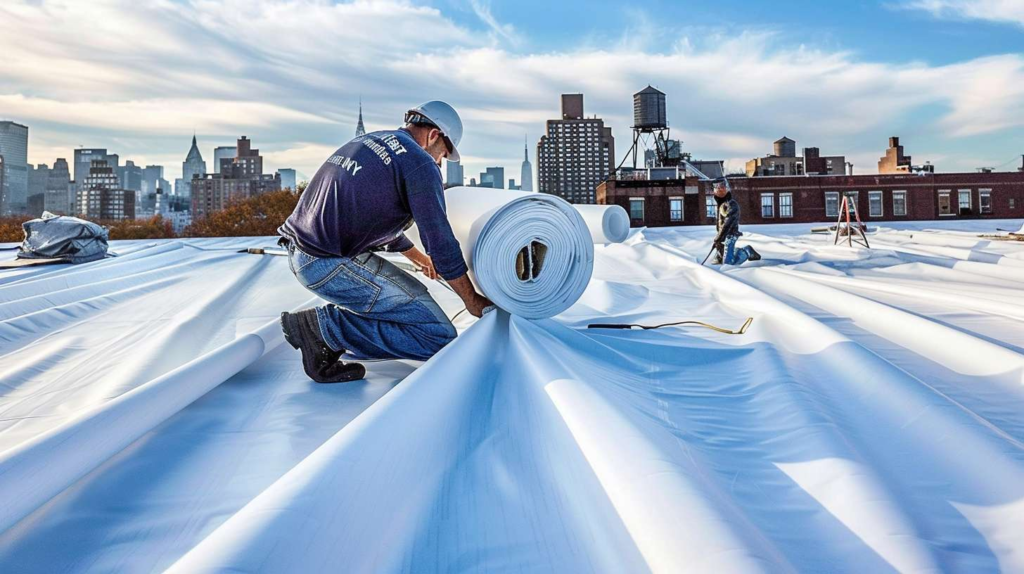
A flat roof installation on a commercial building with a parapet wall, showcasing modern roofing materials and construction techniques.

A 1,200-square-foot roof needing partial deck work, corrected drainage, and three HVAC penetrations is not the same job as a clean new-deck addition with a single drain and straight edges. The per-foot number is the same starting point; the real total depends on every variable the estimate either names or quietly ignores.

Quick Reality Check - Queens Flat Roof Construction

Typical Project Range in Queens

$14,000 - $38,000+

Residential to mixed-use; larger or detail-heavy roofs climb higher

Common Residential Size Example

800 - 1,800 sq ft

Rowhouses, two-families, and rear additions in the most common range

Biggest Price Swing Factors

Deck condition, insulation type, drain count, penetrations, access difficulty

Permits & Design Review

DOB filing can add 2-6 weeks to project timeline

Required on many Queens flat roof replacements and additions

Queens Flat Roof Construction Cost - Scenario Ranges

Scenario Roof Size / Conditions Likely Cost Range Main Cost Drivers
1 800 sq ft addition roof - new deck ready, minimal penetrations $11,000 - $16,500 Membrane system, insulation, single drain, standard edge metal
2 1,200 sq ft rowhouse roof - moderate insulation, 1 drain, standard flashing $15,500 - $22,000 Membrane, insulation thickness, parapet flashing, drain work
3 1,200 sq ft with partial deck replacement and 3 penetrations $19,000 - $27,500 Carpentry, penetration flashing, added labor, potential drain corrections
4 1,800 sq ft two-family - bulkhead, drain work, tapered insulation $24,000 - $35,000 Tapered insulation system, bulkhead flashing, multiple drains, edge coping
5 Commercial-style rear addition - heavy detail work and difficult access $30,000 - $45,000+ Access equipment, staging, heavy edge detail, commercial membrane spec, permits

Ranges reflect Queens labor and material conditions as of current pricing and are not a quote. Your project scope determines your number.

Where the Number Actually Comes From

Decking and substrate work

I'll say this plain: cheap roof numbers are usually missing something important. I remember standing on a two-family in Ridgewood at 7:15 in the morning, coffee still too hot to drink, while the owner showed me a bid that was nearly $9,000 lower than every other estimate he'd gotten. It looked reasonable until I went through it line by line - and as Doreen Velasquez, with 22 years in flat roofing around Queens and a habit of checking exactly which items quietly disappear from low bids, I can tell you what was missing: the bulkhead, the three HVAC penetrations, the rotten perimeter wood, and any mention of how the drainage was going to be handled. I told him, "This is fifth-grade word-problem math - they left out half the problem so the answer would look prettier."

Insulation, membrane, and edge details

The actual cost categories, in order, are these: deck sheathing replacement where needed, rigid or tapered insulation, membrane system, wall and parapet flashing, drain or scupper work, penetration flashing, edge metal or coping, labor and access equipment, and permits. Each one of those is a separate number with its own variables. Tapered insulation alone - the kind that actually creates slope so water moves toward a drain instead of pooling - can add $2 to $4 per square foot over standard flat board insulation. That's $2,400 to $4,800 on a 1,200-square-foot roof before anything else changes.

A roof estimate is a lot like a school worksheet: if the setup leaves out variables, the answer is false. You can do the arithmetic perfectly and still get the wrong total if half the inputs are missing. Now that we've fixed the bad math, let's talk about what the individual line items actually cost in Queens conditions.

Flat Roof Construction Cost - Line-Item Breakdown (Queens)

Cost Component Typical Unit Queens Range What Changes the Price
Deck sheathing replacement Per sq ft $4 - $8/sq ft Extent of rot, accessibility, plywood vs. board sheathing
Rigid insulation (standard) Per sq ft installed $1.80 - $3.50/sq ft Thickness, R-value spec, attachment method
Tapered insulation system Per sq ft installed $3.50 - $6.50/sq ft Slope design, drain location, number of tapered zones
Membrane installation Per sq ft $4 - $9/sq ft System type (TPO, EPDM, modified bitumen), seam count, attachment
Flashing (walls, parapets) Per linear ft $18 - $45/LF Height of upturns, metal gauge, parapet condition
Drain / scupper work Per drain/scupper $450 - $1,200 each New vs. relocation, pipe connection access, leader box work
Parapet coping / edge metal Per linear ft $22 - $60/LF Custom fabrication need, parapet width, metal type
Penetrations (HVAC, pipe, vent) Per penetration $280 - $750 each Size, flashing method, proximity to drains or edges
Permit / admin Per project $800 - $2,500+ DOB filing requirement, engineer sign-off, project scope
Difficult access / equipment Per project $600 - $3,500+ Narrow driveway, rear-only access, no interior hatch, no staging area
Usually underestimated: perimeter carpentry & bulkhead framing Per project $1,200 - $5,500+ Age of building, rotten ledger boards, bulkhead curb condition

âš  Low-Bid Warning Signs on Flat Roof Estimates

A bid with a neat low total and fuzzy scope is almost always where the trouble hides. Watch for estimates that skip any of these specifics:

  • No insulation thickness or R-value listed
  • Drain count not specified - or drainage "included" with no detail
  • Flashing scope described as "standard" without linear footage
  • No deck replacement allowance or language about what happens if sheathing is bad
  • Membrane brand and system not named
  • Number of penetrations not counted or grouped as "misc."
  • Permit costs absent or listed as "if required"

Any of these gaps means the scope isn't complete - and incomplete scope turns into change-order charges after the job starts.

Queens Conditions That Push Costs Higher Than Homeowners Expect

Last winter, on a ladder in Woodside, I had this exact conversation with a property owner who'd gotten three estimates and couldn't understand why they were $11,000 apart. The answer was access and building age. In Queens - whether you're working off Ditmars Boulevard in Astoria, behind a row of attached two-families in Elmhurst, or on a corner building near Junction Boulevard in Jackson Heights - the physical conditions around a roof matter as much as the roof itself. Narrow driveways mean no staging area. Attached homes mean no clean side access. Old parapets mean more carpentry. DOB permit coordination on pre-war buildings means more administrative time. None of that shows up in a per-foot price if the contractor counted only the membrane.

One August afternoon in Astoria, a landlord kept asking why "a simple flat roof" cost more than he expected - and then we opened up the old assembly. Two buried layers, wet insulation that smelled like a basement drain, and a drain that hadn't been properly connected in probably fifteen years. That's a day that stays with you, because it's a perfect example of why the price to build a flat roof from scratch and the number in someone's head are usually two completely different animals. The opened assembly is the real bid. Everything before that is an estimate based on what you can see without cutting in.

Common Flat Roof Cost Assumptions - Myth vs. Real Answer

Myth Real Answer
"Flat roofs are cheaper because they're flat." Slope has to be engineered into the insulation system. A flat roof without designed drainage is a pond waiting to happen - and that drainage work costs real money.
"A square roof is priced like a square box." Bulkheads, parapets, penetrations, and edge conditions all add linear footage and labor that don't appear in the square footage number.
"Small roofs always cost less per square foot." Mobilization, permit minimums, and edge-detail work are largely fixed costs. On a smaller roof, those fixed costs represent a higher per-foot number, not lower.
"Drainage is a minor add-on." Drain and scupper work, including leader box connections and correcting old slope problems, can run $1,500 to $4,500 on its own. It's not an afterthought - it's a system.
"If the old roof looks dry from below, the insulation is fine." Wet insulation in a buried assembly holds moisture without showing any interior signs for years. You won't know until the old layers come off - and by then the deck may need replacement too.

Questions to Ask Before You Trust Any Flat Roof Estimate

What should be listed in writing

What do I ask first when someone says, "How much does it cost to build a flat roof?" I ask them what's written in the estimate they're holding - because a number without scope isn't a price, it's a guess with a dollar sign. Before you accept any bid, you'll want to confirm these in writing: exact square footage counted, whether deck replacement is included or excluded, how many drains or scuppers are in scope, what insulation thickness and slope plan are specified, what flashing metal is being used and where, how many penetrations are being flashed, and what the warranty covers - labor separately from material. Here's the insider reality: the cleanest estimate is not the shortest one. It's the one that names the awkward work - the rotten perimeter wood, the off-center drain, the bulkhead curb - before it shows up as a change order after the contract is signed. A contractor who writes down the problems before starting is one who already looked for them.

✅ Before You Call for a Quote - Gather These First

  1. Approximate roof dimensions (length × width, even rough)
  2. Photos of the current roof surface and the access path - stairwell, hatch, or ladder only
  3. Known leak history, including interior stain locations and when they first appeared
  4. Number of existing drains or scuppers, and whether any are currently clogged or slow
  5. Presence of bulkhead, HVAC units, skylights, or any other roof-mounted equipment
  6. Building type (one-family, two-family, mixed-use) and approximate age of the structure
  7. Any insulation performance concerns or energy efficiency goals for the project
  8. Whether occupancy, business hours, or tenant schedules limit when work can happen

Thin Estimate vs. Complete Estimate - What the Difference Looks Like

Thin Estimate

  • Lump-sum total, no breakdown
  • "Materials included" - brand and system unnamed
  • No drain count specified
  • No deck replacement allowance
  • Flashing described as "standard"
  • Penetrations grouped as "misc. work"
  • Permit cost absent or "if applicable"
  • Warranty not defined

Complete Estimate

  • Line-item breakdown by component
  • Membrane brand, system, and attachment method named
  • Drain count and type specified
  • Deck replacement allowance or clear exclusion with language
  • Flashing scope in linear feet, metal type noted
  • Each penetration counted and priced
  • Permit cost included or explained
  • Labor warranty and material warranty defined separately

The Short Answer on Budgeting Without Fooling Yourself

Here's the blunt truth nobody likes until the leaks stop: budget for the roof you actually have, not the imaginary rectangle in a cheap bid. I once sat on an upside-down flour bucket in an Elmhurst bakery at nearly 11 at night - the only hour the owner could talk - and walked him through decking, insulation, membrane, flashing, and permits one line at a time. By the end he said, "Nobody ever explained where the money actually goes." That's the whole job, right there.

Flat Roof Construction Cost in Queens - Common Questions

Is flat roof construction cost charged per square foot only?

Per square foot is a starting framework, not a final number. Fixed costs - mobilization, permits, drain work, access equipment, edge detailing - don't scale cleanly with square footage. A complete estimate will price some items per foot, others per linear foot, and others per unit. That's correct. A single per-foot number that covers everything is almost always missing something.

Why does insulation change the total so much?

Standard flat rigid insulation and tapered insulation can differ by $2 to $4 per square foot - and tapered systems often require a custom slope design, which adds engineering and layout time. On a 1,500-square-foot roof, that gap is $3,000 to $6,000 in insulation alone. Skipping tapered insulation on a roof with drainage problems doesn't save money; it moves the damage bill to a later date.

Does replacing bad decking happen often in Queens?

Yes - and more often than property owners expect on pre-war stock. Queens has a lot of buildings where the last real deck work was decades ago, and when old membrane and insulation come off, soft or delaminated sheathing is common. Partial deck replacement on a standard roof might run $1,500 to $4,000. Full replacement on a larger roof can go significantly higher. It's not a scare tactic - it's just what the buildings are.

How close can an online estimate get before an inspection?

A ballpark range - useful for budget planning, not for signing contracts. Online calculators don't know whether your deck is solid, how many penetrations you have, what your drain situation looks like, or how difficult your roof is to access. Use an online number to know whether you're in the right conversation. Then get an in-person inspection before trusting any specific total.

If you're ready for a quote that breaks this into clear line items instead of burying scope inside one vague total, call Flat Masters - we'll walk the roof, count the variables, and give you math you can actually hold in your hand. Reach out to the Flat Masters team today and get a real number for your Queens property.

Faq’s

Flat Roofing FAQs: Everything Queens, NY Homeowners Need to Know

How long does flat roof construction actually take?
Most flat roof installations in Queens take 2-4 days depending on size and weather. A typical 1,200 sq ft home takes about 3 days – one day for tear-off and prep, two days for installation. Weather delays are common, so plan for potential extensions during our rainy seasons.
Flat roofing requires specialized skills, proper tools, and safety equipment that most homeowners don’t have. One mistake with membrane sealing or drainage can cost thousands in water damage. Professional installation also includes warranties and insurance coverage you can’t get with DIY.
Waiting typically costs more in the long run. Water damage spreads quickly in Queens’ freeze-thaw cycles, potentially affecting structural beams, insulation, and interior spaces. Emergency repairs during winter storms cost 2-3x normal rates, plus you’ll still need full replacement later.
For single-story homes and additions, absolutely. Flat roofs offer 20-25 years of service when properly installed, easier HVAC access, and potential for future roof deck use. The key is proper installation with quality materials – cutting corners upfront leads to expensive problems.
Most Queens homes built before 1990 need structural assessment before flat roof installation. Signs include sagging ceilings, cracked drywall, or bouncy floors. A professional evaluation costs $300-500 but prevents costly structural repairs mid-project when issues are discovered later.

Ask Question

Or

Flat Roof Rafter Sizing in NYC - Engineered to Carry the Load

5 min read

Renovating a Flat Roof House? Here's Where to Start Before You Spend a Penny

13 min read

Which Waterproofing Material Is Best for a Flat Roof? Here's What Actually Performs

16 min read

Are Flat Roofs Good? Here's an Honest Answer from NYC's Experts

7 min read

Sealing a Flat Roof Leak Sounds Simple - Here's Why It Often Goes Wrong

13 min read

Flat Roof Extension on a Bungalow - Our NYC Team Builds It Right

8 min read

Flat Roof Fall Requirements - What Your Building Needs to Meet Code

7 min read

How Long Does a Flat Roof Really Last Before It Needs Replacing?

13 min read

How Is a Flat Roof Actually Built? Here's the Complete Build Process Explained

17 min read

Flat Roof Joists Carry Everything Above Them - Here's How They Should Be Laid

12 min read

Which Flat Roofing System Is Best for a House? Here's the Homeowner's Guide

13 min read

Leak at the Edge of Your Flat Roof? Here's What's Happening and How to Fix It

14 min read

Best Roofing for Residential Flat Roof: 5 Key Factors to Consider

6 min read

Flat Roof Installation for NYC Properties - Built to Last

7 min read

What to Do When Your Flat Roof Blown Off During Storm Season

7 min read

Heavy Rain on a Flat Roof Doesn't Have to Mean Problems - If the Drainage Is Right

17 min read

Fixing a Flat Roof Leak the Right Way Takes More Than a Tin of Sealant

16 min read

Building a Single Garage With a Flat Roof? Here's What Makes It Right

16 min read

Not Every Coating Company Does the Job Right - Here's How to Find One That Does

14 min read

Can You Actually Tarp a Flat Roof? Honest Answer: It Depends on a Few Things

16 min read

How to Felt a Garage Flat Roof: Professional Installation Guide

6 min read

Ice Dams on a Flat Roof Are a Different Problem - Here's What to Do About Them

13 min read

How Much Does a Flat Roof Repair Actually Cost? Real Prices, Not Guesswork

13 min read

Expert Solutions for Flat Roof Leaking Where It Joins the House

6 min read

How Do You Know When a Flat Roof Actually Needs Replacing and Not Just Repairing?

17 min read
blue circle

Get a FREE Roofing Quote Today!

Schedule Free Inspection