
What's Holding Your Flat Roof Up? Here's the Structural Support It Depends On
Catch it now, before the ceiling tells you first - because what most people call a flat roofing problem usually starts well below the membrane, inside the support system that's quietly carrying everything above it. The surface sheds water, sure, but the structure underneath is what holds the shape, distributes the load, and keeps the whole assembly from losing its geometry over time.
Beneath the membrane, the real roof system is doing the heavy lifting
Seventeen years in, the sag always tells on itself before the leak does. Membranes get patched, coatings get rolled on, drains get snaked - and then six months later the same spot floods again, because nobody looked at what's underneath holding the roof's shape. Joists span the load, beams collect it, decking spreads it, bearing points deliver it to the walls. That's the actual system. The membrane is just the skin on top of something that either works or doesn't.
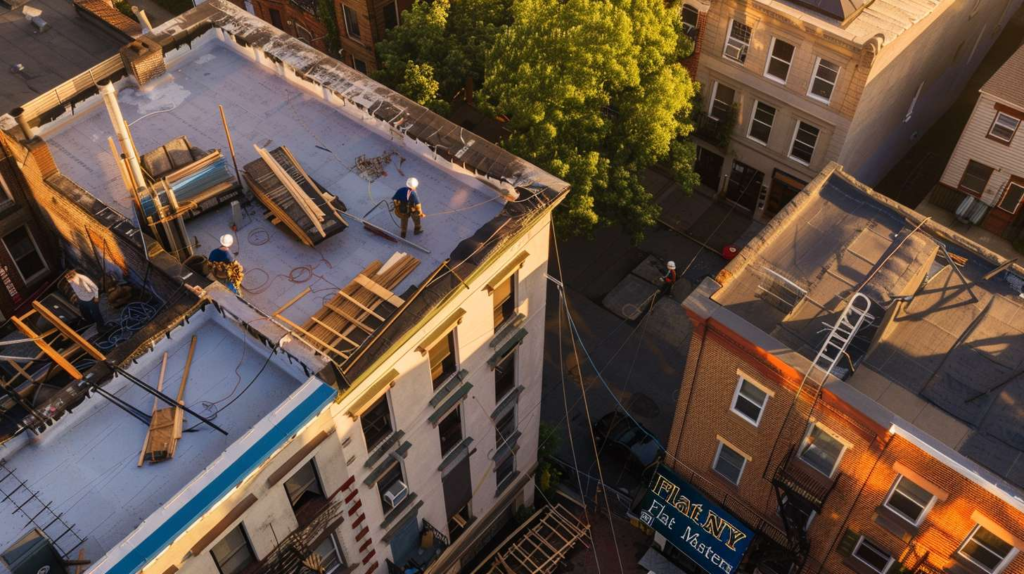
I'm Darnell Vega, and I've been diagnosing flat roof structural support issues across Queens for 17 years - long enough to know that patching a visibly misshapen roof before checking what's underneath is the kind of shortcut that keeps contractors busy for the wrong reasons. Think of it this way: joists are like the strings inside an upright piano, decking is the soundboard, and when the load balance is off, the whole thing goes out of tune no matter how many times you refinish the lid. Patching the membrane while the structure sags is like retuning the keys when the frame is cracked. It's not gonna hold.
| Structural Part | What It Supports | What Failure Looks Like | What Owners Usually Mistake It For |
|---|---|---|---|
| Roof Joists | Span between bearing walls; carry the dead and live load of the roof assembly | Soft bounce underfoot, visible dip across mid-span, recurring ponding in the same band | A drainage problem or a membrane blister |
| Beams & Girders | Collect load from joists and deliver it to columns or walls; define the span's structural logic | Interior ceiling line drops, doors and windows shift, broad roof depression rather than a point dip | Foundation settling or building age |
| Roof Deck | Provides the nailing surface and distributes point loads across joists; holds insulation and membrane | Spongy spots, delamination, membrane tenting, fastener pullout, rotted plywood or OSB | Old membrane failure or insulation breakdown |
| Bearing Walls & Parapet Interfaces | Receive joist ends and transfer roof load to building structure; parapet base anchors edge framing | Cracked stucco at parapet base, edge membrane separation, end-span joist bounce, wall-to-roof gaps | Waterproofing failure at the flashing line |
| Fasteners & Sistered Framing | Hold deck to joists; sistering reinforces weakened spans by adding material alongside existing lumber | Creaking under wind or temperature swings, localized bounce, deck separation from framing | Normal building noise or an attic pest problem |
| Myth | Real Answer |
|---|---|
| "If it only leaks during rain, it must be just the membrane." | Rain-triggered leaks often follow the low point created by structural deflection. The membrane fails where the water collects - which is where the support already gave way first. |
| "Ponding always means the drain is clogged or badly placed." | Drains can't fix a sag. If the roof deck has deflected below the drain elevation, water will pool regardless of how clear the drain is. The fix is structural, not plumbing. |
| "A flat roof should feel perfectly level everywhere." | Flat roofs are designed with slight positive slope toward drains - typically ¼ inch per foot. What feels level often isn't, and what feels off might be intentional. The problem is when it's off in the wrong direction due to load or deflection. |
| "Adding pavers or equipment is harmless if the roof was recently coated." | A fresh coating has nothing to do with load capacity. Adding point loads to a recently coated roof doesn't add structural strength - it adds weight to framing that was sized for something else entirely. |
Load changes are usually the note that throws the whole roof out of tune
What changed up there matters more than most owners think
Here's what I ask in Queens before I even touch a ladder: what changed up there? Attached rowhouses in Jackson Heights and Woodside get pavers slapped down for rooftop seating. Satellite mounts get bolted through decking. HVAC units get swapped out without anyone asking whether the curb framing underneath was built for the new unit's footprint. Old equipment curbs get pulled out and the span never gets reinforced again. One August afternoon in Jackson Heights, I got called out by a restaurant owner near 82nd Street who was convinced the drain contractor had failed him - the roof was holding a lake. By 3 p.m. I'd found the ponding sitting exactly over the span where an old HVAC curb had been removed months earlier. The support beneath it had never been properly restored, so the roof was sagging into the shape of equipment that was long gone.
Added weight, removed equipment, bad remodels, and altered drainage patterns all change the load path through the framing - sometimes in ways that don't show up for a season or two, until weather or an extra load event pushes the system past what it can quietly handle. The membrane above might look fine while the joists below are already working harder than they were designed to. That's the note most owners miss.
Weight & Change Triggers That Commonly Stress Flat Roof Support Systems in Queens
Added Load ↓
- ⚠️ Rooftop pavers - Heavy, concentrated, and rarely accounted for in the original framing design
- ⚠️ Replacement HVAC units - New units are often heavier or have a different footprint than the curb was built for
- ⚠️ Satellite and antenna mounts - Point-loaded fasteners through decking create localized stress without spreading load
- ⚠️ Solar arrays - Distributed but significant dead load added to framing that was never assessed for it
Changed Structure ↓
- 🔧 Removed equipment curbs - Left a span without proper blocking or bearing restoration underneath
- 🔧 Cut joists during interior remodels - Opening for a skylight or duct run reduces span capacity at that section
- 🔧 Mismatched sistering - Wrong lumber species, wrong depth, or too few fasteners means the sister isn't actually carrying the load
- 🔧 Deck overlays - A second layer of plywood added on top of deteriorated original decking adds weight without restoring structural integrity
What Counts as a Meaningful Change?
New weight added
Old equipment removed
Interior renovation below
Drainage pattern changed
Measure the dip before you talk yourself into a patch
How to support a flat roof starts with identifying what is actually weak
On a cold roof, a tape measure and my boots give me more honesty than a sales pitch ever will. The inspection sequence matters: feel for soft or springy areas underfoot, track where ponding water centers itself, get below and look at framing before forming any conclusions above. Measure spans, check deflection, look at how sistering was done and how fasteners are holding. Here's the insider move - always compare what you see on the roof above with what the ceiling lines and walls look like below. A rippled ceiling, a cracked plaster line, or a door that recently started sticking all tell you the structure is under stress. Don't decide on reinforcement until you've read both sides of the same floor-ceiling assembly.
How to reinforce a flat roof depends on span, decking, and connections
How to support a flat roof - and how to reinforce a flat roof when support has already weakened - comes down to a few concrete interventions: temporary shoring while work happens, sistering to code with matched lumber and proper fastener schedules, replacing rotted or delaminated decking sections, adding blocking at bearing points, correcting load transfer at walls, and rebuilding framing around penetrations that were never properly headed off. These aren't DIY moves. The decisions about what to sister, where to add blocking, and how to restore bearing require knowing what the original framing was designed to carry and what it's carrying now.
If the roof changed shape, the structure is already talking.
Blunt truth: a flat roof is only "flat" from the street. A windy November in Ridgewood taught me that clearly - a homeowner met me outside in slippers, absolutely certain she had animals in the ceiling based on the creak above her top floor. I went up into the framing first, and found sistered joists done with mismatched lumber and too few fasteners, likely from a rushed remodel a few years back. Every gust shifted the roof just enough to work those loose connections, exactly like a piano with one cracked bridge pin rattling every time you play a middle-octave chord. How to strengthen a flat roof in that situation isn't about adding material wherever it dips - it's about restoring stiffness and correcting the load path so the framing stops moving when it shouldn't.
Professional Sequence for Diagnosing and Stabilizing Flat Roof Support Problems
- Document visible sag and ponding - Note the location, size, and shape of every low spot and water accumulation area on the roof surface.
- Inspect underside framing - Access the ceiling or structural cavity below to evaluate joist condition, sistering, bearing points, and any previous repairs.
- Measure spans and deflection - Use a straightedge or level to quantify how far the deck has moved from its intended plane.
- Identify load changes - Trace any added equipment, removed curbs, or interior remodel work that altered how weight moves through the framing.
- Determine repair scope with a structural support plan - Define exactly which framing elements need reinforcement, replacement, or re-bearing before any surface work begins.
- Repair framing before membrane restoration - Complete all structural work first so the membrane is installed over a stable, correctly loaded deck.
⚠️ Don't Guess at Joist Reinforcement
Homeowners should not attempt to sister joists, cut into decking blindly, or add rooftop material to "balance" a dip on their own. Undersized or incorrectly fastened sistering can actually worsen load distribution rather than fix it. Cutting into a deck without knowing what's below risks severing wiring or plumbing. And adding weight to one side of a sagging roof to counterbalance a low spot is the kind of logic that leads to collapse scenarios - not solutions. If the structure is involved, get a professional assessment before touching anything.
Maspeth dips, Jackson Heights ponding, Ridgewood creaks: the symptoms have patterns
I remember one building in Maspeth where the puddle wasn't the problem - the dip was. I got the call after an overnight sleet, showed up around 7:10 a.m., and the owner kept describing it as "a roofing problem." I stepped onto the roof near the rear third and felt it immediately - a soft give underfoot that a flat, well-supported deck doesn't have. Went downstairs and found a makeshift plywood patch nailed over ceiling cracks in the back bedroom. The leak was real, but the section had been overloaded with a cluster of concrete pavers and a satellite mount bolted to blocking that wasn't tied into anything structural. The membrane was failing because the deck had deflected. The deck had deflected because the support beneath a concentrated load was never right.
Think of the structure like a piano frame: if the tension's wrong underneath, the top can't perform. That Maspeth call, the Jackson Heights restaurant, the Ridgewood creak - they all resolved to the same pattern when you looked past the surface symptom. A dip you keep stepping around. A ponding spot that forms in the same place every season. A ceiling ripple nobody connected to the roof. A recurring leak that moves slightly every time you patch it. A creak that started after the last remodel. These aren't random building quirks - they're the structure communicating. Queens has shown every shortcut in the book, and honestly, the borough's roofs remember all of them.
Questions Queens owners ask when they realize this is a support issue
Most owners get here after realizing the roof membrane isn't the whole story - they've had it patched once or twice, and the problem came back in the same spot. These are the questions that tend to come up once the conversation shifts from "roofing problem" to flat roof structural support.
What supports a flat roof on a typical Queens house?
Can a sagging flat roof be repaired without full replacement?
How do I know if ponding water is structural or drainage-related?
Can you reinforce a flat roof before adding HVAC, pavers, or a rooftop deck?
Should I call a roofer or a structural engineer first?
📋 Before You Call About a Flat Roof Support Concern - Note These 6 Things
- 📍 Where ponding forms - the exact location on the roof, not just "near the back" or "by the drain"
- 🗓️ Whether the spot is new - has it always pooled there, or did this start recently after a weather event, repair, or installation?
- 🔧 Any recent roof additions or removals - new HVAC, pulled satellite mounts, added pavers, equipment curbs removed or relocated
- 🏠 Interior cracks or patched ceilings below - look at the ceiling directly under the roof area of concern, and note any patched spots, paint bubbles, or plaster cracks
- 🌬️ Noises during wind or temperature shifts - creaking, popping, or movement sounds coming from the top floor or roof structure
- 📸 Photos from both dry and wet conditions - a photo of the ponding when it's active and the same spot when dry tells a lot about how the deck has moved