
Water Sitting on Your Flat Roof After Rain? Here's How to Stop It for Good
Most of the cost is in the delay, not the repair. And her opinion, stated plainly after two decades on Queens rooftops: the most expensive puddle is the one people keep "watching" instead of diagnosing. Repeated water pooling on a flat roof is almost never just a rain volume problem - it's a drainage path or slope problem that keeps sending water back to the same low spot, every single storm, until something gives.
Why the Same Puddle Keeps Coming Back
Most of the cost is in the delay, not the repair. If water keeps showing up in the same place on your flat roof, heavy rain isn't the cause - the drainage path is. Think of it like classroom behavior: if a student keeps ending up in the same seat causing trouble, you don't blame the schedule. You look at what the room is allowing. A ponding problem that returns after every storm is the roof telling you its geometry is routing water back into a low spot instead of out of it.
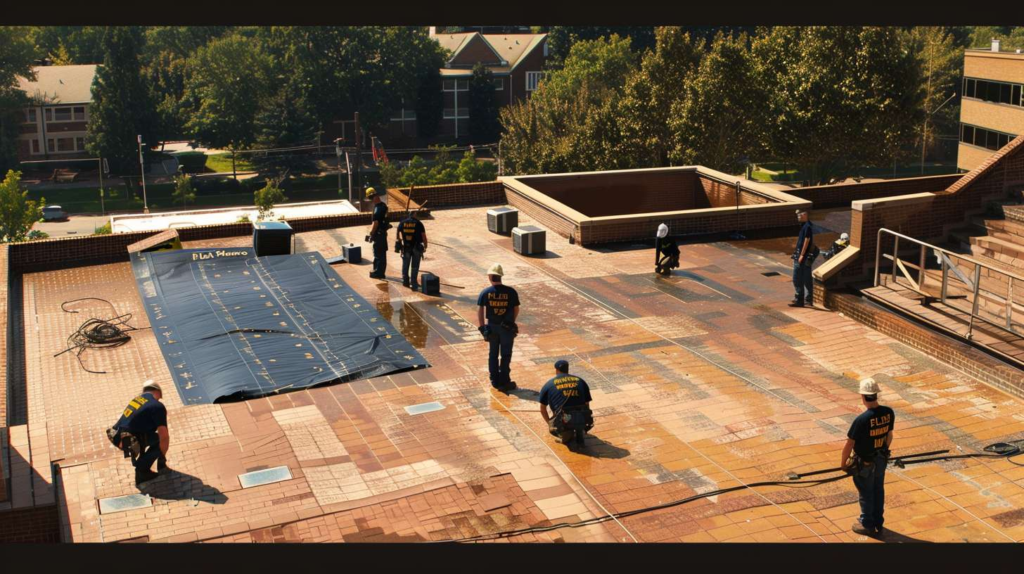
Two inches from the drain tells me more than the whole rest of the roof. What you find right there - compressed membrane, a clogged flow line, bad taper, wrinkled seams, or a depression that physically sits lower than the drain collar - that's your answer. And that pattern, as Darlene Velez has seen over 22 years diagnosing repeat ponding on Queens flat roofs, usually means the roof is draining back into a depression rather than out of it. I stepped off a hatch on a two-family in Ridgewood at 6:40 in the morning, fog still low, owner insisting the roof was "basically dry now" - and watched my boot disappear into a shallow pond hiding a membrane seam. The insulation underneath had already started losing its shape. The water wasn't the only problem. It never is.
| Myth | What the Roof Is Actually Doing |
|---|---|
| "It only happened because the storm was unusually bad." | The storm filled the low spot faster, but the low spot was already there. A properly sloped roof sheds heavy rain. A depression collects it every time, light drizzle included. |
| "If it dries by tomorrow, it's fine." | Evaporation is not drainage. The insulation beneath the membrane absorbs moisture long before the surface looks dry. Repeated wet-dry cycles are what compress substrate and break seams over time. |
| "A fresh patch will stop the problem." | Patching the leak point without correcting the slope means water still trains to the same seat. The patch buys time - sometimes - but the low area keeps collecting water and stressing whatever you put over it. |
| "Flat roofs are supposed to hold some water." | Industry standard flags standing water after 48 hours as a ponding concern. A code-compliant flat roof has enough slope - at least ¼ inch per foot - to move water to a drain or scupper. Sitting water for days is a design or settlement failure, not normal behavior. |
| "If the drain is open, the roof is draining correctly." | An open drain can sit physically higher than the surrounding depression due to deck settlement, membrane build-up, or add-on insulation layers. Water pools around a drain that's too proud of the field - the drain is open, but unreachable from the low point. |
Signs the Roof Geometry Is Wrong, Not Just Wet
A flat roof is never truly flat, and that misunderstanding costs people money. There are obvious signs - ring stains left on the membrane like a tide mark, algae that traces the exact edge of where water settles, seams that show stress wrinkles from repeated saturation. Then there are the less obvious ones: a roof that feels slightly soft underfoot near an old repair, interior leaks that track back to the same ceiling corner no matter how many patches go up, and water that rolls right back into the same dip when you sweep it away. One August afternoon in Elmhurst, I had a landlord trailing me in office shoes while I demonstrated three separate low spots with a push broom. Every time I moved the water, it rolled back to the same groove like a marble on a kitchen table. He'd paid for patch work twice. Neither patch touched the slope, so the ponding kept its same appointment. Queens buildings compound this - multiple reroof layers stacked over decades, patched drains sitting at different heights, aging rear extensions that have settled independently of the main structure, and mixed-material assemblies that all create hidden low paths water learns quickly.
What a Contractor Should Test Before Proposing a Fix
That sounds logical, but here's what the roof is actually doing when you just eyeball a puddle from the hatch: it's hiding the geometry problem underneath a visible one. A competent flat roofer should follow a diagnostic sequence before naming any solution - check the drain collar height relative to the membrane field, verify taper direction, probe the substrate for wet or compressed insulation, inspect every scupper and internal gutter for partial blockage or height mismatch, map every depression that holds water, and document how long water remains after a known rain event. Visible puddles point a direction. The diagnostic tells you whether the answer is a drain adjustment, a taper correction, a localized rebuild, or a larger scope of work.
| What You See | Most Likely Cause | What Usually Fixes It |
|---|---|---|
| Pond forms directly around drain | Drain collar sitting proud of the field; partial blockage at bowl | Drain bowl reset, flow-line clearing, or drain relocation |
| Pond forms between seams, not near drain | Deck settlement or substrate compression creating mid-field low area | Tapered insulation add-on or cricket installation to redirect slope |
| Water line remains visible 24-48 hours after rain | No viable slope path to drain; water evaporating rather than draining | Full slope correction; possible drain addition or repositioning |
| Roof feels spongy underfoot in wet area | Insulation saturated and compressed from repeated ponding cycles | Localized tear-off, substrate replacement, and membrane rebuild |
| Repeated interior leak below same ceiling area | Active membrane breach at seam or flashing, fed by standing water | Membrane rebuild plus drainage correction - fixing one without the other fails |
| Water moves when pushed, then returns to same spot | Geometry low point; surrounding slope funnels water back | Tapered insulation, cricket, or partial deck rebuild to eliminate the dip |
Fix Options That Actually Stop Ponding for Good
Here's the blunt part nobody likes hearing. Coating over a dip or patching the leak point without touching the slope is temporary - and often not even that. The water comes back because the low spot is still there, still collecting, still stressing whatever you laid on top of it. The real solutions are: clearing and adjusting drain height, adding tapered insulation to build slope back into the assembly, installing crickets to divert water around obstacles, replacing saturated insulation that no longer supports the membrane properly, resetting sections of membrane, or in some cases rebuilding part of the deck itself. Here's the field shortcut worth knowing: if you give water a clear path and it still finds its way back to the same spot, you're looking at a geometry issue, not a blockage. That single test separates a drain-cleaning job from a taper-correction job - and those are very different scopes of work.
I remember one roof in Sunnyside where the water had better attendance than the tenants. Same corner, same puddle, storm after storm, three different crews over four years. None of them changed the slope. The puddle was a repeat troublemaker - same seat, same behavior - because the system around it never changed, never gave it a reason to go anywhere else. Once we added a tapered insulation build-up and reset the drain path, that corner dried out after the first rain and stayed dry. That's the difference between treating the symptom and correcting the geometry.
| Repair Strategy | Pros | Cons |
|---|---|---|
| Drain cleaning only | Fast, inexpensive, fixes the problem when debris is the sole cause | Fails immediately if the drain collar sits above the depression - open drain, still useless |
| Drain reset | Addresses collar height directly; useful when drain has been raised by membrane layers over time | Doesn't correct a field low spot that sits far from the drain's new position |
| Tapered insulation add-on | Builds slope back into the assembly without full tear-off; works well over dry, intact substrate | Cannot go over wet or compressed insulation - adding taper over saturated substrate traps moisture and accelerates rot |
| Localized tear-off and rebuild | Removes compromised material; allows full slope correction and fresh membrane in the problem zone | Higher cost; needs to be scoped correctly or the adjacent low spot becomes the next problem |
| Full reroof section | Best long-term control; resets slope, drainage, and membrane across a defined area | Significant investment; only justified when moisture damage, repeated failure, or age make smaller fixes impractical |
When to Monitor It and When to Call a Queens Flat Roofer Immediately
If I asked you where the water goes after hour twelve, could you answer me? That's the real question. A shallow puddle that clears within a normal drying window - say, a warm afternoon after a light rain - is different from standing water that's still sitting there the next morning, then the morning after. Timing matters enormously. I got a Sunday call around 7 a.m. from a restaurant owner in Astoria, right before he opened, because he could hear dripping over the prep area. When I got up on that roof, there was a broad, lazy depression near an old drain, and the ring line on the membrane wasn't from that one storm - it was from water sitting in that same spot day after day, season after season. He'd been watching it. Nobody had been diagnosing it. Water that keeps returning to the same seat near an old drain is not a weather event. It's a geometry warning, and it doesn't get quieter the longer you wait.
A puddle that keeps returning is not an event; it is a pattern.
Questions Homeowners Ask Before Approving the Repair
Think of water like a stubborn eighth-grader: it will always find the weakest supervision. Every time. And that frames the questions you should be asking before signing off on any flat roof repair. Are you fixing the leak point or the low spot that keeps feeding it? Is the insulation wet - and if so, is it being replaced or just covered? Does the drain currently sit proud of the depression, meaning it can't actually catch the water pooling around it? And after the work is done, how are you verifying water now has a clear path out? Those four questions will tell you fast whether the contractor in front of you is solving the problem or delaying it. - Darlene Velez, Flat Masters
If water keeps sitting in the same place on your Queens flat roof, don't let another patch decision waste your money - contact Flat Masters to inspect the slope and drainage path and find out what the roof is actually doing.