
Water Through the Top Floor Ceiling? Your Flat Roof Is the First Place to Look
Measure the crack before you call. Write down how far the ceiling stain sits from the nearest wall or door frame, because that measurement is going to matter when someone gets up on that flat roof and starts tracing where water actually entered - and it's almost never directly above what you're staring at. This is a leak-tracing guide built specifically for Queens properties, where the gap between roof entry point and ceiling evidence can span an entire room.
Why the ceiling spot keeps pointing at the wrong place
Measure the crack before you call. That stain on your top floor ceiling is not evidence of where the roof failed - it's evidence of where water got tired of traveling and finally dropped. Leaks are misdirection tricks. The water enters at one point, hitchhikes along insulation, deck seams, or a parapet edge, and shows up somewhere that makes no sense until you trace the path. Water is a liar. The ceiling is just where it introduces itself last.
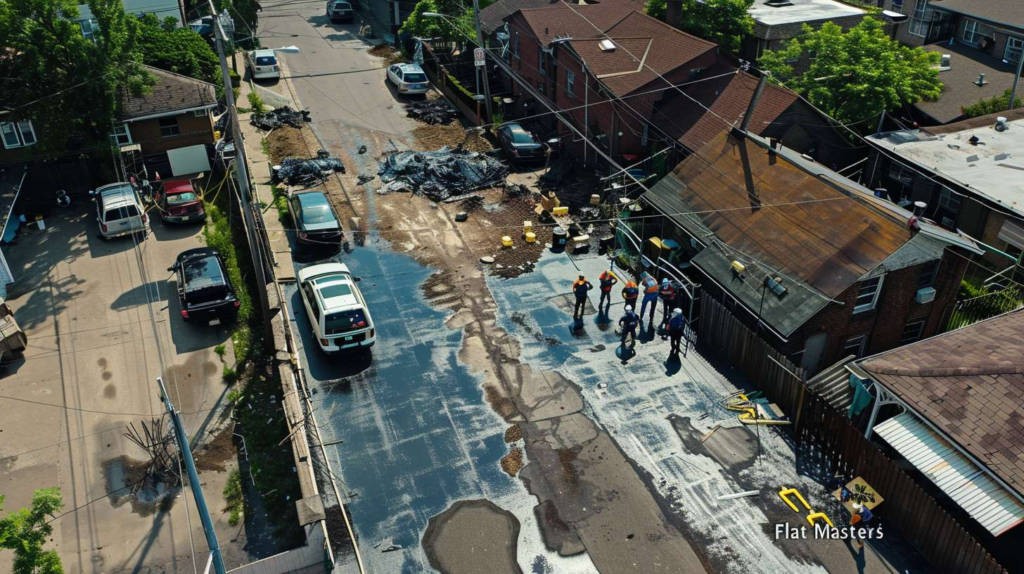
On a Queens roof, six feet is nothing to water. I remember a 6:40 a.m. call in Forest Hills after a night of cold spring rain, where the owner swore the stain above the top floor hallway had to be from a pipe. I got up there, saw the blistering near a drain bowl, and told him before I even unpacked my moisture meter: that water started on the roof, not in the ceiling. He looked offended for about ten seconds, then the drip started again right in front of us. Water follows insulation seams, rides the pitch of the deck, pools behind parapet edges, and sneaks through old openings before it ever announces itself indoors. And honestly, I get impatient when people point at the stain and call it evidence - the stain is usually just the last stop on a longer trip.
| Myth | What Actually Happens on a Flat Roof |
|---|---|
| "The stain marks the hole." | Water travels along the deck pitch, insulation seams, and flashing edges before dripping down. The entry point can be 4-8 feet away from the ceiling spot - sometimes more. |
| "If it only leaks during heavy rain, it's minor." | Volume-triggered leaks mean the membrane or flashing has a gap that only opens under water pressure or ponding. Minor-looking gaps in a flat roof can allow significant subsurface saturation between storms. |
| "The super patched it last year, so that area is ruled out." | A surface patch covers the visible area but often redirects water under the membrane to the path of least resistance - which is typically somewhere nearby. Prior patches are suspects, not clearances. |
| "A leak near a bathroom must be plumbing." | Roof water travels horizontally before it drops. A top floor bathroom stain that appears after rain or thaw - not after a shower - is more likely a roof-path issue than a supply or drain line problem. |
| "No drip during inspection means no roof issue." | Flat roofs absorb and hold moisture in the insulation layer for days or weeks. A dry ceiling during a dry week doesn't mean the roof is sound - it means the water is waiting for the next trigger. |
Signals that make this a top-floor roof problem, not a random interior drip
Patterns after wind, thaw, or drain backup
Here's the part people don't enjoy hearing: the stain shape doesn't tell you much. The timing does. If the ceiling shows up wet after wind-driven rain, after a rapid snowmelt, or after a drain sat submerged under standing water, you're almost certainly looking at a roof-path issue - not a coincidence. Rosa Mendez, with 19 years in flat roofing and a specialty in repeat top-floor leak tracing in Queens, will tell you that pattern recognition solves these faster than any probe you can stick in a ceiling. The event that triggers the drip is the first real clue, and most owners miss it because they're focused on the stain, not the weather log.
What do I ask first when someone says the leak is "right there"? I ask when it appears - is it during rain, hours after, or during thaw? I ask about wind direction, because a leak that only shows up during westerly wind is practically signing its name. I ask whether it gets worse after a freeze-thaw cycle. And I ask whether the top floor sits directly under a roof hatch, a parapet wall, a drain, or an old equipment mount. In Queens, that last question almost always opens the case: attached row buildings with shared parapet walls, hatch curbs that haven't been resealed in fifteen years, leftover satellite hardware on modified bitumen roofs from Flushing to Richmond Hill - these are the setups where top floor specific leaks get misread every single time.
| What the Resident Notices | When It Happens | Most Likely Roof Area to Inspect First | Why That Clue Matters |
|---|---|---|---|
| Ceiling stain appears or worsens during rain only | During or within hours of rainfall | Nearest drain bowl, membrane seams above the stain | Rain-triggered leaks point directly to membrane or flashing failure, not interior systems |
| Drip only during wind from one direction | During westerly or northerly wind-driven rain | Parapet flashing on the windward side, gaps behind mounts or conduit | Wind forces water into gaps that gravity alone can't reach; the directional pattern locates the wall |
| Wet ceiling after snowmelt, not during snowfall | Day or two after a fast thaw | Roof hatch curb, low-pitch areas where melt pools before draining | Meltwater volume overwhelms compromised seals; hatch corners are the most common thaw-leak culprit |
| Stain in hallway, not inside an apartment | After any storm or temperature swing | Overhead parapet wall, hatch frame, or old penetration above the hallway | Hallway stains often trace back to parapet cap failures or hatch edges, not interior plumbing |
| Bubbling or soft ceiling near top of wall | Ongoing, worsens with weather | Parapet flashing termination and coping cap condition | Water entering at the parapet top runs down the wall cavity before appearing inside at the ceiling-wall joint |
Fast Truths About Leak Behavior
Visible Stain Delay
A ceiling stain can take 24-72 hours to appear after water first enters the roof assembly.
Typical Travel Distance
On a flat roof, water routinely travels 4 to 10 feet horizontally before dropping through to the ceiling below.
Wind-Driven Rain Effect
Wind forces water into gaps at angles that standard drainage design doesn't account for, creating entry points that only activate in specific weather conditions.
Why Top-Floor Units Show Symptoms First
The top floor ceiling is the first interior surface water reaches after passing through the roof assembly, making it the building's earliest warning system.
Where I would trace the path first on a Queens flat roof
Start above the stain, then move uphill and sideways
Last February, I stood by a hatch with sleet hitting my glasses and watched this happen in real time. Sunday evening emergency in Ridgewood, three-family house, grandmother on the top floor with a soup pot under the drip, very calm, telling me: "It only leaks when the snow melts fast." She was exactly right. Under that hatch curb, someone had done a patch-over-patch repair that trapped water in a pocket between the layers. When the thaw came hard and fast, water funneled straight into the top floor ceiling seam like it had been waiting for an invitation. The hatch was maybe three feet from where she'd placed the pot. That one was actually straightforward - but it only looked that way because we started at the roof detail, not the drip.
Blunt truth: ceilings snitch late. By the time you see the stain, water has already been moving through the roof assembly for a while - sometimes days, sometimes weeks. The actual tracing order that works: start at drain bowls and check for ponding rings, then follow flashing turns at every edge, then check parapet caps and coping for gaps, then move to hatch curbs and pitch pockets, then look for abandoned penetrations left from old equipment, and finally - pay close attention to any area where a repair was applied over a previous repair. That's the insider tip I hand out freely: patch-over-patch zones don't seal the water entry edge, they redirect it. Water slides under the older layer and travels a new path, and the next ceiling stain appears somewhere nobody expected.
If you are staring at the stain and not the roof details around it, the leak is already winning.
Exact Roof-Tracing Sequence for a Top Floor Flat Roof Leak
Mark the ceiling location and measure from fixed interior points
Note the stain's distance from two fixed reference points - a wall, doorframe, or hallway. This measurement lets a roofer identify the corresponding area on the roof deck with precision instead of guessing.
Identify the weather pattern and timing
Log when the drip appeared relative to rain, wind direction, snowmelt, or temperature swings. This pattern narrows the roof zone before anyone steps outside.
Inspect the nearest roof detail directly above the stain area
Check drain bowls, membrane seams, and any flashing termination within the corresponding roof zone. Look for blistering, separation, or ponding rings as immediate tells.
Move uphill and toward parapets or penetrations
Water doesn't travel downhill on a flat roof the way it does on a pitched one. Follow the roof's slight pitch, parapet walls, and any penetration uphill from the suspected entry zone.
Check for failed prior patches and moisture spread
Any patch-over-patch area deserves extra attention. Probe the edges of prior repairs with a moisture meter - wet readings at the perimeter of an old patch mean water is traveling under it, not through it.
Confirm with moisture testing or controlled water testing if safe
A calibrated moisture meter - I prefer the Tramex Roof and Wall Scanner for subsurface reads on modified bitumen - can confirm saturation without cutting the membrane. Controlled hose testing isolates specific zones when the path remains unclear.
The roof details that fail quietly
A flat roof leak behaves more like spilled ink than a dropped stone. Ink spreads outward from where it lands, follows the grain of what's beneath it, and shows up at the paper's edge long after the spill happened in the center. On Queens flat roofs specifically, west-driven weather is a repeat offender - it pushes water behind parapet caps, into coping gaps, and under flashing that looks sealed from above but has a lifted edge on the windward face. Clogged or slow drains compound this by creating temporary ponding that forces water into every low spot and seam within reach. That's the misdirection trick flat roofs pull consistently, and it's why the ceiling stain in the east bedroom sometimes traces back to a parapet gap on the west wall.
What to document before a roofer arrives so the leak gets solved faster
Good documentation doesn't just help the roofer - it prevents another guess-patch. A photo of the stain, a note on when the drip started, and a rough room measurement from the nearest wall give a flat roofing crew a real starting point instead of a blank slate. The more precisely you can tie the ceiling evidence to a weather event and a location, the faster the path gets traced and the less likely you are to get a surface repair that misses the actual entry point entirely.
✓ Before You Call: Queens Owner & Tenant Checklist
-
1
Photo of the stain - taken from a consistent angle, ideally with a reference object for scale. Take one now even if it's dry. -
2
Video of active drip if safe to capture - note whether it's a steady drip or intermittent, and which direction any ceiling bulge is forming. -
3
Time the leak started - and the weather conditions at that moment (rain, wind, snowmelt, temperature change). This one detail often pinpoints the roof zone. -
4
Recent weather condition - note wind direction if known, duration of rain, or whether there was a fast thaw after snow. Screenshots from a weather app work fine. -
5
Room location measured from a wall or hallway - two measurements from fixed points, so the roofer can cross-reference on the roof deck without guessing. -
6
Whether the building has a roof hatch, parapet wall, or drain above the area - a quick yes/no on each helps narrow the first inspection points before the crew arrives. -
7
Whether any prior patch or repair was done recently - who did it, approximately where, and when. Prior work is a clue, not a guarantee, and it needs to be on the table from the start.
⚠ Mistakes That Make a Top Floor Roof Leak Harder to Trace
- Painting over the stain before inspection. Paint hides the stain edges and dries out moisture clues. A roofer looking at a freshly painted ceiling can't read the pattern - and the pattern is the point.
- Poking holes in ceiling bulges. A water-filled ceiling bubble holds pressure. Puncturing it without towels and a bucket ready causes damage and destroys evidence of how long water has been pooling.
- Assuming it's plumbing without checking weather correlation. If the stain appears after rain and not after someone uses the bathroom, it's probably not a pipe. Check the weather log before you call a plumber.
- Letting someone apply cement to one suspect spot without tracing the path. A surface smear of roof cement over an obvious crack does nothing if water is entering six inches away and traveling under the membrane. Spot-only repairs on untraced leaks almost always come back.
Questions owners ask when the leak keeps coming back
Repeat leaks are where I see the most frustration - and the most wasted money. One August afternoon in Astoria, I was on a roof so hot the modified bitumen was practically breathing. The top floor tenant kept reporting that the leak only came during wind from the west, which sounded oddly specific until I got to the parapet and found a gap hidden behind an old satellite mount near the Jamaica Avenue side of the building. The ceiling stain was in the bedroom, the entry point was on the west parapet face, and two previous patches had been applied nowhere near it. That case illustrates exactly why top floor flat roof leaks that keep returning after patching almost always mean the visible stain was mistaken for the source. If you're on your third repair and the water is still coming in, the path hasn't been traced - it's been guessed. Flat Masters is the call you make when the guessing stops working.
| 🚨 Call Now | 🕐 Can Wait Briefly |
|---|---|
| Active dripping near light fixtures or electrical panels | Old, dry stain with no recent weather correlation and no active moisture |
| Ceiling visibly sagging or bulging with water weight | Cosmetic discoloration already inspected with no moisture detected in the assembly |
| Leak reoccurs during every rain event, no dry periods between | Minor surface mark with no active moisture, roof visit already scheduled within 24-48 hours |
| Visible mold growth or dark spreading around the stain edges | |
| Water actively entering around a roof hatch or parapet wall after a storm |
If the leak keeps coming back, the path hasn't been found - and another patch on the same wrong spot won't change that. Call Flat Masters and let us trace the full route from roof entry to ceiling stain, so the next repair actually holds.