
Leak at the Edge of Your Flat Roof? Here's What's Happening and How to Fix It
I've done this long enough to know that when a flat roof leaking at the edge leaves a stain on your ceiling, that stain is almost always pointing you somewhere wrong-because the perimeter failed quietly first, while the water took its time finding a path indoors. This article breaks down where the edge missed its cue, how the water traveled, and what actually fixes it on Queens rooftops.
Why the Stain Lies While the Perimeter Fails
I've done this job in every kind of Queens weather, and the one thing I keep coming back to is this: a flat roof edge doesn't fail with a bang. It fails like a bad actor making a quiet entrance from the wrong side of the stage-nobody sees it happen, but by the time the scene plays out, water is dripping on a bedroom ceiling two rooms over. The perimeter goes first. A loose metal edge, a failed termination bar, a lifted flashing detail-any one of these lets water in offstage, and then it travels under the membrane or along the nailer before it ever shows up where you're standing with a bucket.
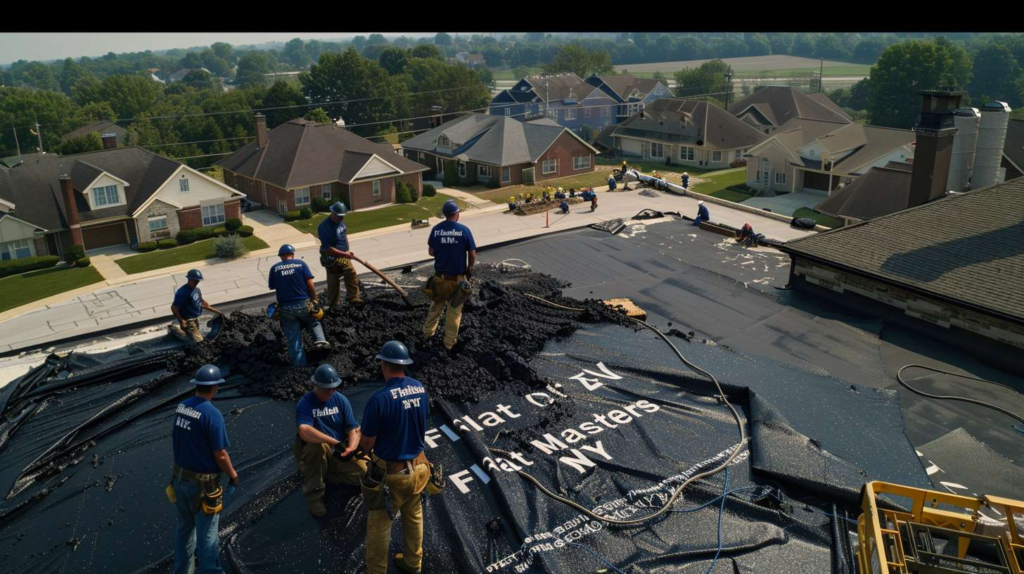
At the front edge in Queens, I look down before I look around. People always want to start with the stain, which I get-that's the visible problem. But the stain is just where water decided to clock in for the day; it doesn't tell you where it punched in. I was on a two-family in Ridgewood at 6:10 in the morning after a windy overnight rain, and the owner kept pointing to a ceiling stain near the front bedroom window. I walked the roof edge first, not the stain, because the metal gravel stop was chattering loose in the gusts. Sure enough, water had been getting under the edge flashing and traveling sideways for a while before it ever showed up indoors. That's the move every time: read the perimeter before you trust the ceiling.
Where Edge Leaks Usually Start on Queens Flat Roofs
Metal Edge and Gravel Stop Movement
Here's the part people never enjoy hearing. Edge leaks are almost never dramatic holes-they're detail failures. Missed cues in the perimeter script. I'm Marco, and I've been tracing flat roof leaks in Queens for 19 years; I'm specifically known for catching edge failures that other crews write off as skylight or wall leaks. The older mixed-use buildings in Astoria, Ridgewood, and Jackson Heights were built with minimal perimeter overhang, which means the edge metal takes a direct hit from wind. Corner positions are the worst-two planes of wind pressure meet right at the lap, and if the gravel stop or drip edge has worked its fasteners loose, you've got an open seam that breathes water every time the weather comes sideways.
Membrane Shrinkage at the Termination Line
I remember one roof on 37th Avenue in Astoria where a restaurant owner was convinced the HVAC units were leaking-the water only appeared when the AC was running hard during August heat. It turned out not to be the units at all. The edge membrane had shrunk just enough to pull back from the termination point, and the afternoon heat opened the gap a little wider each day. That's a classic summer setup on Queens commercial roofs: the middle of the membrane expands, the perimeter detail is already under tension, and something at the termination line finally gives. It looked fine until you stopped staring at the middle of the roof and actually read the edge.
If the perimeter detail missed its cue, the water does not care what room you blamed.
| Edge Source | What You May Notice Indoors | What Shows Up on the Roof Edge | Typical Repair Path |
|---|---|---|---|
| Loose gravel stop / drip edge | Stain near front wall or top-floor ceiling corner | Raised metal, missing or backed-out fasteners, visible gap at lap | Re-fasten, seal laps, replace damaged edge metal sections |
| Failed termination bar | Water appearing at exterior wall top or just inside it | Membrane pulling away from wall, open seam at bar edge | Remove bar, re-adhere membrane, install new termination bar and sealant |
| Parapet flashing separation | Stain running down an interior wall face, not ceiling | Flashing lifted or buckled at parapet base, open lap at cap transition | Re-flash parapet base, secure cap, check counterflashing |
| Membrane shrinkage at edge | Intermittent leak tied to heat or sun exposure cycles | Membrane pulling back from termination point, visible gap widening | Extend membrane to new termination, properly adhere and seal |
| Old equipment mount patch at edge | Leak appears after storm, often near corner or side wall | Patched area hidden under coating, soft or bubbled to the touch | Remove patch, dry substrate, apply proper membrane repair and edge seal |
| Split membrane at outside corner | Stain appearing near corner of building, sometimes both walls | Cracking or open split where membrane wraps the outside corner | Install pre-formed corner piece, adhere and seal all transitions |
▼ Failed Termination Bar and Fasteners
▼ Lifted Flashing at Parapet Transition
▼ Patched Holes from Old Mounts or Signs
▼ Split Membrane at Outside Corners
How to Tell If You Need an Emergency Visit or a Planned Repair
If you were standing next to me, I'd ask one thing first: where did you see it after the wind picked up? That question does more diagnostic work than looking at the stain ever could. A leak that appears specifically during or right after wind-driven rain, especially from a consistent direction, is almost always a perimeter issue. A leak that shows up only after prolonged standing water is more likely a field or drain problem. Timing and wind direction together tell you where to look; a single wet spot after one storm tells you almost nothing on its own.
Blunt truth: the edge is where a lot of "mystery leaks" stop being mysterious. I got a call one drizzly Sunday from a landlord in Jackson Heights who told me three different contractors had blamed the parapet. I did a slow lap and found a sloppy old patch at the roof edge-leftover from a satellite mount removal years back, half-buried under silver coating that had been rolled over it like a cover-up. When I lifted that patch, trapped water came out like somebody missed a cue and rushed the entire stage at once. Here's the insider read on that: old silver coatings and patchwork at the perimeter can hide the real seam failure completely. Don't trust the shine. Probe the transitions and terminations directly-press on them, check for soft spots, look for bubbling-because the coating will look fine right up until it doesn't.
What Not to Do Before Someone Repairs the Edge Correctly
Temporary Moves That Buy Time Without Pretending to Solve It
A flat roof edge is like a badly timed actor-miss one cue and the whole scene gets messy. When I see someone's already been up there with a caulk gun, smearing sealant across metal laps and calling it a repair, I know right away the real problem is still running its lines backstage. Random caulk at an edge joint doesn't stop movement-and edge metal moves constantly with temperature. Roof cement smeared over a lifted flashing is just a costume change; the breach is still open underneath. Coating over a movement point is the same thing with a shinier finish. And honestly, "just caulking the edge" isn't a repair plan-it's a delay tactic that sometimes makes actual diagnosis harder because now you've got material hiding the original failure line.
That said, there's a limited and honest role for temporary protection while you wait for a proper inspection. If water is getting into the building, protect the interior-buckets, plastic sheeting on valuables, whatever stops secondary damage. Document when the leak appears, whether wind was involved, and which direction the rain was coming from. That information is genuinely useful when the roofer shows up. What you don't want is hidden moisture quietly spreading into the wood nailer at the roof edge, the wall top, or the fascia area-because by the time that's wet enough to notice, you've got a bigger repair conversation than you started with.
- Smearing sealant over metal laps bridges the joint temporarily but can't hold through thermal movement-when it cracks, the gap is now under a layer of hardened sealant that traps water instead of shedding it.
- Burying open seams under aluminum coating makes the roof look sealed from the surface, but the coating is not a membrane. Water enters through the seam and is now contained under the coating, accelerating substrate damage invisibly.
- Ignoring loose fasteners at the perimeter because "the coating looks fine" allows the edge metal to continue moving and widening the gap at the lap-until the next wind event pulls it open further than any sealant can cover.
If the leak keeps showing up after wind or along an exterior wall, stop guessing and call Flat Masters to inspect the roof edge before a small perimeter failure quietly turns into soaked decking and interior damage that costs three times more to fix.