
Base Sheet Goes Down First - and Getting It Right Matters More Than Most Know
Play this out: the layer most owners never see again - the one buried under everything - is often the layer deciding whether the whole roof behaves for the next fifteen years or starts failing quietly from the inside. That's not a metaphor. That's the reality of base sheet installation on flat roofs in Queens, and it's where the serious work either happens or gets skipped.
Why the Hidden Layer Decides the Roof's Future
At the drain, I pay attention first. Not at the top coat, not at the edge metal, not at whatever the crew is rolling out with confidence - at the drain, because that's where tension collects, water migrates, and base sheet stress shows up earliest. The base sheet for flat roof systems is the layer that gets walked on, fastened through, and then covered up while everyone stands back and admires the finish membrane. And honestly, that's the problem in a sentence: people love to admire the top coat while ignoring what actually carries stress. The hidden layer is already under load before the roof is even finished.
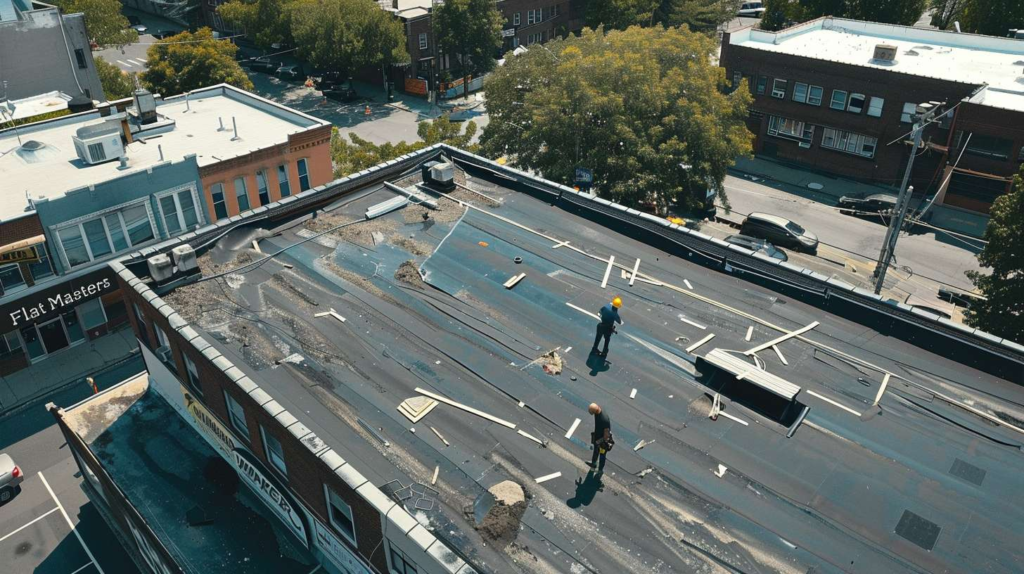
And Marta Zielińska, with 19 years in flat roofing focused on catching base-sheet prep mistakes before they disappear under the system, sees this problem constantly in Queens - owners taught to care about the wrong layer first, which is completely backwards. Base sheet installation is where alignment starts or breaks, where fastening discipline either holds or doesn't, and where seam behavior gets baked in permanently. By the time the cap sheet goes down, the decisions underneath are locked in. There's no tuning it after the fact.
Quick Facts - Base Sheet Installation on Queens Flat Roofs
Most Overlooked Layer
Base sheet - covered before most owners ever inspect it
Most Sensitive Spots
Drains, parapets, and penetrations - every one of them a stress point
Failure Pattern
Wrinkles and lifted seams in the base telegraph upward through every layer above
Best Time to Catch Mistakes
Before the cap sheet or coating goes down - after that, you're guessing
| Myth | Real Answer |
|---|---|
| "The cap sheet does all the waterproofing." | The cap sheet is the finish layer, not the foundation of the system. If the base sheet fails at a seam or drain, water finds a path the cap never sees until it's too late. |
| "A small wrinkle in the first layer is harmless." | Wrinkles trap stress. Queens sees real temperature swings - freeze-thaw cycles in January, July heat loading - and that wrinkle becomes a crack origin over time. |
| "Fastener spacing can be eyeballed." | It can't. Uneven fastening creates differential movement. The membrane pulls toward anchored zones and away from the gaps. You end up with stress lines running exactly where you don't want them. |
| "If it looks flat from the street, it's fine." | Street-level looks tell you nothing about seam alignment, fastener pull-through, or drain transition detail. A roof that looks calm from below can be under serious tension up top. |
| "New top layers erase bad prep." | They don't. They bury it. Bad prep in the base shows up as bubbling, movement, and early delamination in the layers above - sometimes within one hard rain season. |
Where Base Sheet Installation Goes Wrong Before the Roof Even Looks Finished
Seams, Edges, and Drains Are the First Stress Points
Here's the part people love to skip: substrate readiness. Before a single roll gets laid, the deck surface has to be clean, dry, free of old fastener heads that haven't been set flush, and clear of debris that will create a high spot under the sheet. Straight runs matter too - if you start your layout crooked, every seam drifts from there. The whole thing builds tension into the system before a single fastener goes in. And not for nothing, older Astoria and Ridgewood roof lines have a way of exposing small prep mistakes fast: irregular parapet heights, drains that were patched over once or twice already, wood nailers that have shifted over decades. Those neighborhoods don't hide sloppy layout for long.
Minor Misalignment Becomes a Major Leak Path Later
I remember a roof on 37th Avenue where the owner had a cousin insisting we could rush the flat roof base sheet work because "the cap is what keeps water out anyway." I was on that two-family in Astoria at 6:40 in the morning, fog still hanging low, and by 9:15 I had him looking at a wrinkle telegraphing right through the run near the drain line. I remember thinking: this is what happens when people treat the first layer like packing paper. The wrinkle wasn't cosmetic. It was stress already in the system, and it was pointing straight at the most vulnerable spot on the whole roof.
If you were standing next to me on this roof, I'd ask you one thing: do you want a roof that merely looks finished today, or one that stays quiet when a nor'easter starts pushing sideways rain at it for six hours? Because those are actually two different roofs, and they diverge at the base sheet. Now go one layer lower - fastening and seam control are where that divergence is decided, not at the surface.
| Checkpoint | What Correct Work Looks Like | What Failure Looks Like | Why It Matters Later |
|---|---|---|---|
| Deck Condition | Clean, dry, flush fasteners, no soft spots or debris | High spots, old fastener heads, wet pockets under sheet | Creates bridging and stress concentration at every high point |
| Sheet Alignment | Straight runs from drain logic point, consistent overlap | Drifting lines, uneven overlap, sheets forced into position | Seams never seal correctly when sheets are under lateral tension |
| Fastener Spacing | Consistent pattern per spec, field and perimeter zones distinct | Random placement, clustering near edges, gaps in field | Membrane pulls unevenly; stress lines form between fastener clusters |
| Seam Overlap | Minimum overlap maintained, seam bonded and rolled flat | Inconsistent width, lifting edges, unbonded sections | Water finds the shortest path - a lifted seam is an invitation |
| Drain Detailing | Sheet cut cleanly to drain ring, fully bonded, no voids | Wrinkled transitions, gaps at drain ring, sheet not fully set | Standing water migrates under the sheet edge; rot or delamination follows |
| Parapet Termination | Sheet run up wall to spec height, secured and sealed at termination bar | Short terminations, unsealed edges, sheet not secured at wall | Wind and hydrostatic pressure peel the system from the wall outward |
Do you want the roof to look flat, or do you want it to stay calm when Queens weather starts pushing on it?
⚠ Don't Let These Slide - Owner Alert
If a crew tells you "we'll flatten it with the next layer" or "the finish membrane will cover that," stop the job. Those phrases are red flags, not reassurances. The base sheet does not get a second chance once it's buried.
Three concrete danger signs to look for before the top layer goes down:
- Random fastener pattern - if it doesn't look deliberate, it wasn't
- Wrinkles running toward drains - stress is already pointing at your most vulnerable transition
- Lifted corners at edges - a corner that won't stay down on day one will be a water entry point by year two
How a Disciplined Crew Installs a Flat Roof Base Sheet Without Building In Stress
Bluntly, a pretty top layer can lie to you. I've seen coatings that look perfect - clean edges, good color, no visible seams - sitting over a base sheet that was essentially already failing. The sequence matters: layout first, then dry-fit to confirm alignment before anything gets fastened or adhered, then fastening from the drainage logic point outward, seam treatment at every lap, and edge control at parapets and penetrations before the next layer ever comes near the roof. One August afternoon in Jackson Heights, the sun was so hard on the membrane rolls that my gloves felt warm through the palms, and a property manager kept asking why I was making my crew stop and re-align the flat roof base sheet at the parapet. I told him we don't build stress in and then hope the next layer compensates. Two months later, after a heavy sideways rain, he called back to admit the neighboring building had seepage and his didn't. Not gonna lie - I did enjoy that one.
A roof stack-up is a lot like tuning a piano string - the tension you set at the anchor point travels through the whole length, and if it's wrong at the base, you'll hear it eventually, usually under pressure. The hidden tension is the real enemy here, not the visible surface. Everything quiet on top can be coiled tight underneath, waiting for the right load - a freeze cycle, a wind event, a hard rain at an angle - to show you where the prep failed. I've spent 19 years in flat roofing learning to listen for the hollow part, the way a string that's slightly off resonates wrong when you tap it. That's the insider move worth taking from all of this: before you ask a contractor about coating color or warranty length, ask exactly how they handle drains, how they align seams at parapets, and what their fastening pattern looks like in the field versus the perimeter. Those answers tell you everything the finished surface won't.
Professional Installation Sequence - Base Sheet for Flat Roof
Inspect the Substrate
Walk the entire deck. Mark soft spots, proud fasteners, moisture pockets, and debris. Fix all of it before any material is unrolled.
Skip this: High spots and wet zones become blister origins locked under the finished system.
Dry-Fit Alignment
Roll out sheets without fastening to confirm straight runs, consistent overlap, and correct orientation relative to drainage.
Skip this: Drift builds in early and compounds at every subsequent seam across the roof.
Begin at the Drainage Logic Point
Start layout at the low point or drain and work uphill so water sheds over seams, not into them.
Skip this: Seam laps face the wrong direction and create direct water entry paths at every joint.
Fasten or Adhere to Spec
Use the specified fastener pattern - distinct field and perimeter zones, consistent spacing, no improvising.
Skip this: Uneven fastening creates differential pull; stress lines form between over-fastened and under-fastened zones.
Set Seams with Discipline
Bond every seam lap fully, roll it flat, and verify no voids or lifting edges before moving to the next run.
Skip this: Unsealed seams become water channels the moment the first significant rain event hits.
Verify Perimeter and Penetration Transitions
Confirm parapet terminations are at correct height and secured, drain transitions are bonded, and all pipe and vent penetrations are detailed before the next layer goes down.
Skip this: Every undetailed penetration and parapet edge is a future leak waiting for the right weather event to announce itself.
Questions to Ask Before You Approve the Next Roofing Layer
What You Can Verify Without Climbing the Roof
I once got called to a patch job in Forest Hills after another crew had laid a new system over a base that was fastened like they were hanging holiday decorations - random spacing, lifted corners, no discipline at the seams. It was just after sunset, porch light on, the homeowner in house slippers, and I had to explain that the expensive-looking top layer wasn't the real story. The real story was underneath, where nobody had bothered to get the base sheet installation right. The surface looked immaculate. The system beneath it was already in motion. That's the version of "finished" that costs owners twice.
Before You Approve - Owner Checklist
-
☐
Ask what substrate issues were corrected - soft spots, moisture, proud fasteners - before work started -
☐
Ask how seams were aligned - did the crew dry-fit first, or just unroll and fasten? -
☐
Ask for the fastener or adhesion method - mechanical, fully adhered, hybrid - and whether it matches what the spec called for -
☐
Ask how drains were detailed - was the sheet cut cleanly to the ring, fully bonded, with no voids at the transition? -
☐
Ask how parapets and edges were handled - run height, termination bar, and seal at the wall -
☐
Ask whether photos were taken before the top layer covered the base sheet work - a confident crew documents it
Owner Questions - Flat Roof Base Sheet Work
If a Queens roof is about to get its next layer and nobody has shown you proof the base sheet was installed correctly - call Flat Masters before that hidden mistake gets buried for good.
- Marta Zielińska, Flat Masters, Queens, NY