
Planning a Flat Roof Extension? Here's What It's Really Going to Cost You
Starting numbers help, but the tie-in to the house is what starts changing them
I've held this opinion for a long time: the flat roof extension cost conversation goes sideways not because the number is unknowable, but because most people hear a starting range and stop listening right there. A basic flat roof extension in Queens typically runs $4,500-$9,500 for the roof portion alone - and yes, that number can climb well past $15,000 once detailing, structure, access complications, and tie-ins to the existing house start stacking up. The surface area is the easy part. It's everything the surface has to connect to, drain away from, and stay sealed against that moves the price.
For a basic extension roof, here's the number range that usually gets the conversation honest: $4,500 on the low end assumes a simple shape, a clean and uncomplicated tie-in to the existing wall or roof, ordinary access, standard insulation build-up, and no unpleasant surprises at the edges or in the drainage logic. The moment any one of those assumptions breaks, the number adjusts - sometimes a little, sometimes a lot. I'm Martin "Marty" Cevallos, and I've spent 21 years pricing and building flat roof extensions in Queens by separating the homeowner's plan, the house's reality, and the weather's opinion. I call those three things my buckets: what you planned, what the house planned, and what weather tries to add. Most jobs start in bucket one and quietly grow into all three before the work is done.
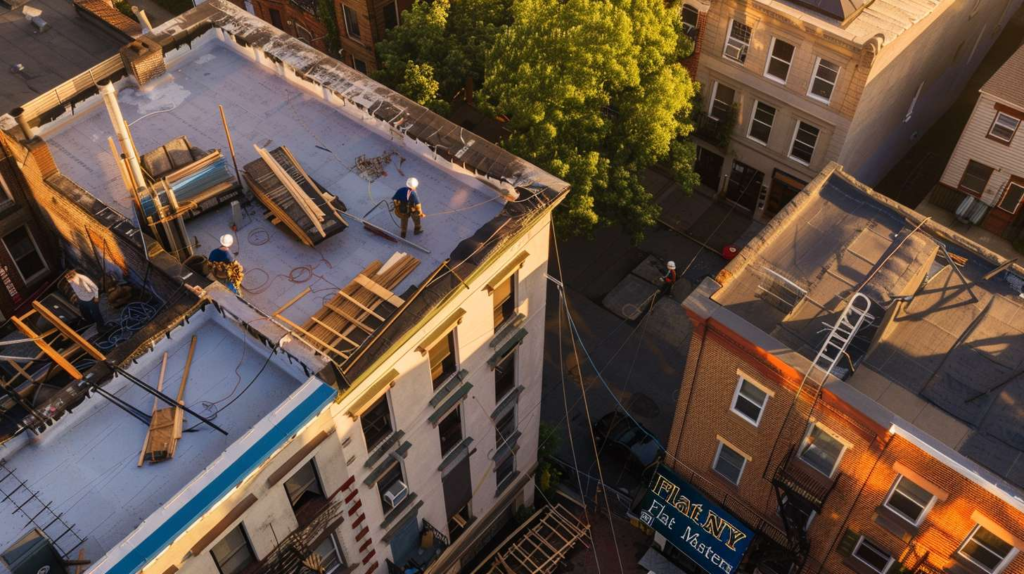
Roof-portion estimates only - not full extension budgets
| Scenario | What the roof portion includes | Representative Range | What pushes it upward |
|---|---|---|---|
| Basic small rear extension roof | Membrane, insulation, standard edge trim, simple drain or scupper | $4,500 - $7,500 | Older decking, tight pitch, or non-standard dimensions |
| Extension roof with rooflight / skylight detail | Membrane, insulation, upstand detailing, frame curb, flashing, skylight unit | $7,000 - $12,000 | Multiple rooflights, lantern framing, structural opening complications |
| Extension roof with tricky tie-in to existing house | Membrane, insulation, careful stepped flashing, existing wall prep, overlap detailing | $7,500 - $13,500 | Deteriorated existing wall, mismatched roof levels, chimney or bump-out interference |
| Extension roof with access / staging complications | Membrane, insulation, plus scaffolding, material hoisting, limited-access labor premium | $8,500 - $14,500 | Narrow lots, tall building walls adjacent, no rear-yard vehicle access |
| Extension roof with parapet or drainage redesign | Membrane, insulation, parapet coping, new drain layout, internal or external drainage routing | $10,000 - $18,000+ | Parapet height changes, conflict with existing drains, flat-to-flat transitions |
What a "Basic" Estimate Usually Assumes
Simple Connection
A clean, accessible tie-in to the existing wall or roof with no hidden complications. If the existing wall has water damage, missing flashing, or unusual construction, this assumption is gone and price adjusts.
Standard Insulation Build-Up
Typical rigid insulation to current energy code requirements. If the deck needs leveling, unusual thickness, or a hot-roof configuration is required, this assumption changes the material cost fast.
Manageable Access
Materials can reach the roof without scaffolding or significant hoisting labor. Narrow side yards, adjacent fences, and low overhead utilities all violate this assumption - and every Queens neighborhood has at least one of them.
Uncomplicated Edge & Drain Detail
Straightforward drip edge or low parapet with a simple scupper or drain route to grade. The moment drainage has to route around obstacles or fight existing downspout locations, this assumption disappears with it.
Connections, rooflights, and drainage are where the cheerful early budget usually starts arguing back
A neat rectangle becomes a roof system the second it meets the old house
I still remember that dog running off with my pencil during a cost talk - bright April afternoon in Astoria, a couple at their kitchen table asking how much is a flat roof extension and wanting one clean number before we'd even had five minutes of real conversation about what the new roof would actually attach to. Fair enough; they wanted a starting point. But once I walked the site and looked at the wall junction, figured out where drainage needed to go, and heard that they wanted a rooflight in the middle of the new space, the budget bands shifted pretty quickly. I ended up sketching three cost scenarios on the back of a tile sample - low, realistic, and "this-is-what-the-house-wants." Their dog grabbed my pencil on the second sketch and sprinted toward the living room. We laughed, but honestly that dog had the right idea. Simple questions rarely have simple answers once a real building joins the conversation.
Before we answer how much is a flat roof extension, what is this new roof actually connecting to? In Queens rear additions - think the older semi-detached rowhouses off Metropolitan Avenue, or the attached homes with tight lot lines you'll find throughout Jackson Heights - the existing house wall is rarely clean and cooperative. It might have old flashing that's already failing, a mismatched roof height, or a parapet detail that doesn't accommodate the new work gracefully. And that's before you factor in rooflights, which homeowners love for the light they bring to a rear kitchen or family room. Every penetration is a new detailing challenge, every drainage route is a decision between bucket two (the house's plan) and bucket three (what weather will eventually try to find). That's the honest version of the cost conversation.
| Detail or Condition | Why It Matters | What Part of the Estimate It Changes |
|---|---|---|
| Existing wall tie-in | The new roof must seal against the old building without inheriting its water problems | Labor and risk - bad tie-ins are where future leaks start |
| Rooflight or lantern opening | Every opening needs a curb, upstand, flashing, and the right insulation treatment around the frame | Materials and labor - mostly the detailing, not just the unit cost |
| Drainage route design | Water has to go somewhere specific; routing around obstacles or existing drains adds work | Labor and sometimes structural - if the deck needs repitching |
| Parapet or edge detail | Taller parapets, coping changes, or drip-edge complications affect both material quantity and detailing time | Materials - coping and flashing costs add up faster than people expect |
| Insulation build-up | Code-compliant R-value in a flat roof assembly requires more thickness than a sloped roof - and that affects deck height | Materials - premium rigid board adds cost but can't be skipped |
| Access / material staging | Getting materials to the deck safely in a tight Queens rear yard is a real logistical problem | Labor - staging time and scaffolding are pure cost with no visible material to show for it |
⚠️ Watch Out: "It's Just a Simple Roof Over the New Room"
Treating the extension roof as a separate lid you drop onto the new room is the fastest way to build yourself a future leak problem. The new roof isn't independent - it's a waterproofing connection to an older building that has its own quirks, its own weak points, and its own water history. Every junction, penetration, and edge condition on the old structure affects how the new roof needs to be detailed. Ignore that, and the "simple roof" becomes an expensive repair within a few seasons.
The room below gets the glamour, but the roof above is what protects the investment from becoming a leak experiment
An extension roof estimate is a lot like building an event platform - flat on paper, full of complications at the edges. I spent years putting up temporary banquet decks and event floors before I moved into roofing full-time, and the lesson was identical every single time: the platform is easy, the perimeter is where the work actually lives. Extension roofs are the same. The membrane over the middle of the room is the straightforward part. What costs real money is the edge detailing, the connection to the house, the insulation thickness, the drainage logic, and any penetrations you decide to punch through the surface. Owners who emotionally invest in the kitchen below - the tile, the cabinetry, the light fixtures - often assume the roof is just surface area priced by the square foot. It's not. It never was.
My opinion? People underbudget the roof because the room below gets all the excitement. I can prove it. One humid June evening in Sunnyside, I was standing in a half-finished shell with homeowners who had budgeted beautifully for the kitchen they were putting in downstairs and almost casually for the flat roof extension above. Beautiful countertop selections, a serious appliance package, real thought put into every finish - and then a vague, wishful number for the roof. I had to explain, in a sweaty open shell around 6 p.m., that flat roof extension cost isn't a square-footage multiplication. It's structure, insulation, edge detailing, the penetrations for the rooflights they wanted, and the not-small question of how the new roof was going to meet the existing house wall without turning the kitchen below into a water feature in three years. That conversation realigned the budget. The roof got the respect it deserved.
Here's the blunt truth: rectangles become expensive the moment they meet real houses. And here's the insider question worth asking before you accept any extension roof quote - find out which parts of the price belong to the new roof itself and which parts belong to making that new roof behave correctly against the existing building. A cheap quote often low-balls the second category. It'll price the membrane and the insulation, and it'll quietly undercount the tie-in work, the flashing complexity, and the staging reality. Ask the question. If the contractor can't separate those two cost buckets clearly, that's information too.
Questions That Expose Whether an Extension Roof Quote Is Realistic
-
✔
How does the new roof tie into the old house - and has the contractor physically looked at where that connection happens? -
✔
What exactly happens at the wall junction - is there existing flashing being removed, replaced, or worked around? -
✔
Where does water actually leave this roof, and is that exit point included in the quoted scope? -
✔
What penetrations are included - rooflight upstands, pipe collars, exhaust vents - and are they fully detailed in the price? -
✔
What edge detail is assumed - simple drip edge, low parapet, or coping - and is that what the design actually requires? -
✔
What access difficulty is priced in - has the contractor visited and seen the yard, the side passage, and the staging situation? -
✔
What weather protection or temporary dry-in is expected during the build - especially if the shell is open during installation?
Weather and access are the quiet troublemakers that show up late but charge early
The site always gets a vote
For a basic extension roof, here's the number range that usually gets the conversation honest - and it's also the line I use when someone's about to find out their simple rectangle isn't quite what they thought. A Ridgewood estimate comes to mind every time I say this. The owner opened with, "It's just a rectangle, how bad can it be?" Reasonable question. Then I walked the site. Limited access through a narrow side gate, a parapet on the rear wall that needed coping work before anything could tie in cleanly, and a drainage layout that wasn't going to work without some thought about where the new downspout would land relative to the existing one three feet away. By the time we finished talking through it he said, "So the roof has opinions too." Exactly. The rectangle on the plan doesn't have access problems. The rectangle on the plan doesn't have a parapet with old, cracked coping. The actual roof - the one on the actual house on the actual Queens street - does. That's why the price range is a starting point, not a ceiling, and why sites that look simple on paper keep earning the right to be called complicated.
| The Myth | The Fact |
|---|---|
| "A simple shape means a simple price." | Shape is one variable. Access, tie-in complexity, drainage routing, and edge detailing all price independently of how many corners the plan has. |
| "The roof should be a small line item in the extension budget." | The roof portion of a well-done extension regularly runs 15-30% of the total project cost. Treating it as a rounding error is how you end up with a beautiful room and a waterproofing problem. |
| "Rooflights only change the look, not the budget much." | Every rooflight needs a structural opening, a curb, an upstand, flashing, and careful insulation continuity around the frame. A single rooflight can add $1,500-$4,000+ to the roof portion of the budget. |
| "Access is a contractor problem, not a cost factor for me." | Staging and access difficulty translate directly into labor hours and equipment cost, which land in your quote. Tight Queens lots with fence lines, utility lines, and narrow side passages are a real pricing variable. |
| "If the room plan is settled, the roof plan is basically settled too." | The room plan tells you the footprint. The roof plan answers how drainage exits, where tie-ins land, what edge detail is required, and what penetrations get detailed. Those are separate decisions with separate costs. |
Flat roof extension cost is a real number, and you deserve a quote that treats it that way - one that prices the roof, the tie-in, and the site honestly before the budget starts lying to you. Call Flat Masters today and get a flat roof extension estimate that's built around your actual house, your actual Queens lot, and what the work actually takes - not what sounds good before someone's seen the site.