
Flat Roofs Aren't Just for Houses - Here's Every Type of Building That Uses Them
I'd rather you hear this now than in six months. People walk past buildings with flat roofs every single day in Queens - on the way to the subway, past the pharmacy, next to the school - without registering just how many different property types depend on them to function. This breakdown covers exactly which buildings use flat roofs and why, so you stop guessing and start seeing the pattern.
The city is full of flat roofs hiding in plain sight
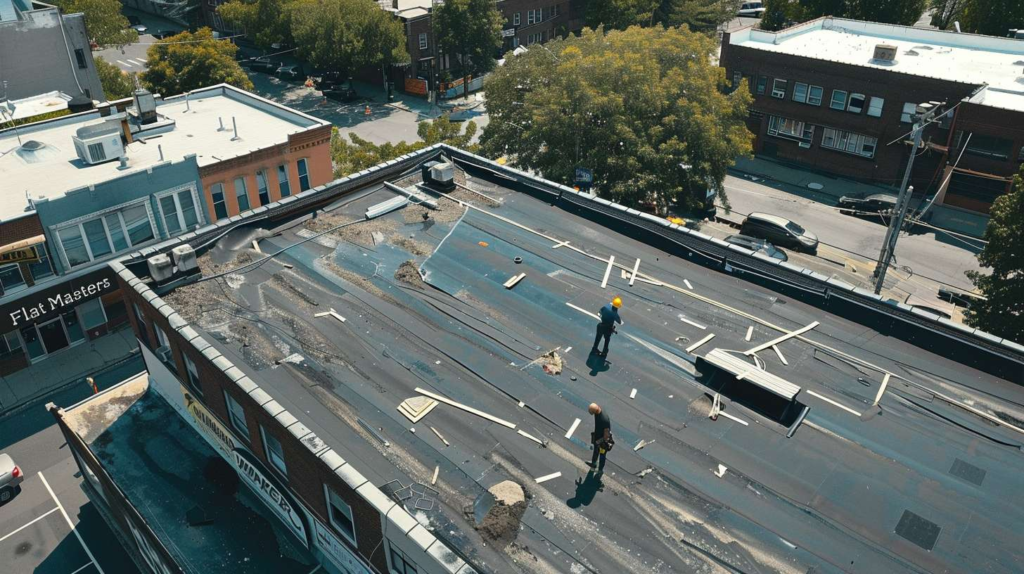
On Queens Boulevard alone, you can count five before the light changes. Mixed-use storefronts, a medical office above a nail salon, a school annex tucked behind a church, a small apartment building with a rooftop water tank - all flat. All chosen for reasons that have nothing to do with design trends and everything to do with what the building actually needs. Think of it like a tabletop: from the street it looks perfectly level, but once you put weight on one corner - an HVAC unit, a service path, a drain that's been patched twice - the whole story shifts. That's the roof telling you where it really works hard.
Now tap this corner for a second, because the list below is longer than most people expect.
-
🏢
Apartment Buildings
Multiple floors of plumbing, HVAC, and rooftop tanks need a flat platform for safe equipment access and even load distribution. -
🏪
Mixed-Use Storefront Buildings
Retail below, residential above - a flat roof handles mechanical units for both without a peaked structure eating into rentable square footage. -
🏫
Schools
Wide-span structural systems and multiple HVAC zones make flat roofing the practical match for large, single-story and multi-story academic buildings. -
🏥
Medical Offices
Imaging equipment, supplemental cooling, and electrical conduit runs require a rooftop that functions as a utility platform, not just a lid. -
🏭
Warehouses
Huge footprints demand low-pitch or flat systems because a sloped roof at that scale would add significant structural cost with no real benefit. -
🏬
Office Buildings
Telecom equipment, rooftop terraces, and multi-unit HVAC systems all justify the flat layout - and make the rooftop a working floor, not wasted space. -
🏛️
Community Centers
Flexible interior layouts, multipurpose halls, and tight city lots push designers toward flat roofing that doesn't constrain interior clearance heights. -
🛍️
Retail Strip Centers
Uniform parapet height across multiple storefronts keeps signage lines clean while concealing HVAC above each individual tenant's space. -
🔧
Rear Extensions & Additions
Additions built into tight backyards or between party walls can't accommodate a pitched structure - flat is the only thing that fits the setback and the neighbor's wall. -
🚒
Small Municipal & Service Buildings
Firehouses, utility substations, and transit facilities use flat roofs because budget, function, and access for ongoing maintenance outweigh aesthetic variety.
| ❌ Myth | ✅ Fact |
|---|---|
| Flat roofs are only for houses with a modern or minimalist design. | The majority of flat roof buildings in Queens are commercial, mixed-use, or institutional - chosen for function, not aesthetics. |
| All flat roofs are truly level - water just sits on them. | A proper flat roof has a slight built-in slope (typically ¼" per foot) directing water to internal drains or scuppers. Truly level means it was installed wrong. |
| A sloped roof is always the smarter choice in New York City. | In dense Queens neighborhoods with zero-lot-line construction and shared walls, a steep-slope roof often can't be built at all - flat is the structural answer, not a compromise. |
| Flat roofs are only used on cheap or low-budget buildings. | High-performance flat roofing systems - TPO, EPDM, modified bitumen - are specified on hospitals, schools, and office towers precisely because they perform under demanding conditions. |
| Flat roofs can't support heavy HVAC or rooftop equipment. | Flat roofs are specifically engineered to carry rooftop loads. That's one of the primary reasons buildings with significant mechanical equipment choose them - a pitched roof makes that equipment placement nearly impossible. |
Why certain properties choose them on purpose
Utility space changes the decision
Here's the part people get backwards. Most of the time, a building doesn't end up with a flat roof because the budget ran out or nobody cared - it ends up with one because the building's function demanded it. As Marisol Vega, with 19 years in flat roofing and a specialty in solving drainage trouble on flat roofs between two buildings, I've seen flat roofs blamed for problems that were really about ignoring how the building was actually using the roof. The membrane isn't the villain. The decision-making around it is.
If you owned this building tomorrow, what would you need that roof to do? Hold three HVAC units and let technicians reach them without a ladder truck? Fit inside lot lines that share a wall with the neighbor's building? Keep the construction cost from blowing the project budget on a structural ridge system nobody can see from the street? Allow for a future addition over the rear extension? A flat roof for a building handles every one of those conditions in a way a pitched system simply can't match on a tight Queens lot.
Now tap this corner for a second.
Blunt truth: a flat roof is rarely just "flat." In Queens, you're dealing with parapets that trap snow drift, rear additions that box in drainage, narrow lots where the neighboring wall acts as a second edge, and buildings where three different occupancies share one membrane. The setback conditions near Woodhaven Boulevard are different from what you're working with on a corner lot in Elmhurst - and both are different from the flat roof tucked between two taller buildings in Long Island City. Local conditions shape every design call, and that's why a one-size answer almost always costs somebody money eventually.
Lot shape and neighboring walls matter too
| Building Type | Main Roof Purpose | Typical Rooftop Load/Use | Why Flat Roofing Fits |
|---|---|---|---|
| Medical Office | Utility platform + weatherproofing | Supplemental HVAC, conduit, imaging unit cooling | Equipment density requires flat, accessible surface with precise penetration control |
| School Annex | Low-maintenance cover over wide span | Rooftop HVAC units, minimal foot traffic | Wide structural bays favor flat systems; budget and maintenance scheduling align |
| Mixed-Use Retail/Residential | Separation of commercial and residential systems | Multiple HVAC zones, possible rooftop terrace | Flat membrane handles multiple mechanical zones without ridge-line complications |
| Warehouse | Large-span weatherproofing at low cost | Minimal equipment, large open membrane field | Pitched systems at warehouse scale are structurally costly with no functional gain |
| Office Building | Equipment platform + potential tenant amenity | Telecom arrays, rooftop terrace, multi-unit HVAC | Flat surface allows rooftop to function as a usable floor rather than dead structural space |
| Rear Commercial Addition | Cover squeezed between party walls | Usually light or none - service access only | Zero-clearance setback conditions make a pitched structure physically impossible |
| Apartment Building | Protect multiple residential units + support mechanicals | Water tank, HVAC, plumbing vents, elevator housing | Even load distribution and safe technician access are easier on a flat membrane |
| Community Facility | Flexible cover over variable-height interior spaces | HVAC, skylights, possible solar panels | Interior ceiling heights vary; flat roof doesn't constrain multipurpose room clearances |
One roof style, very different demands by building type
I remember a superintendent in Sunnyside saying both his building and the dental office next door had "the same flat roof" - same color, same parapet height, probably the same installer years ago. But one had three HVAC units, a water tank, and a service path that got walked every two weeks. The other had almost nothing on it. Same material, completely different performance demands. That difference is exactly what I was thinking about at 6:15 in the morning on top of a small medical office in Rego Park, coffee going cold on the parapet, when the office manager told me the roof should be simple because "we only use that wing for imaging." It wasn't simple - three rooftop units, extra conduit runs, and a service path squeezed into one corner that a technician hit every single week. Flat roofing for healthcare buildings isn't just weatherproofing. It's a utility management problem wearing a roofing membrane on top of it.
Think of it like a tabletop with weight in the wrong corner. A healthcare roof stresses the membrane near equipment curbs. A school roof stresses it along the service hatch path and at drain collars after every hard rain. A retail roof gets hit at penetrations around tenant HVAC swaps every few years when a new business moves in. And a mixed-use building? All of the above, sometimes on the same membrane. Here's the insider tip worth holding onto: the busiest corner of a rooftop is where wear starts, even if the visible leak shows up fifteen feet away where the water finally found a seam to travel through. You're always chasing where water lands, not where it begins.
🏥 Healthcare Buildings
Rooftop Equipment Reality: Supplemental cooling units, generator exhaust stacks, medical gas venting, and dense conduit runs can turn a modest roof into a mechanical floor. The curb count alone on a mid-size medical office often exceeds what you'd find on a building twice its size.
Traffic & Maintenance Pattern: HVAC technicians, electricians, and sometimes imaging equipment vendors all need regular rooftop access. Service paths get walked year-round, compressing the membrane in specific corridors well before the rest of the field shows wear.
Failure Point Owners Underestimate: Penetration collars around conduit and curb flashings. They get disturbed during service visits, never properly resealed, and the leak shows up two seasons later inside a room that's nowhere near the rooftop work area.
🏫 Schools and Annexes
Rooftop Equipment Reality: Central HVAC units, rooftop exhaust fans for kitchen and lab ventilation, and in older Queens school buildings, oversized mechanical equipment that hasn't been updated since original installation.
Traffic & Maintenance Pattern: Infrequent but high-stakes. Roof access typically happens during scheduled breaks - winter recess, summer break - which means problems can sit unnoticed for months before anyone's up there to spot them.
Failure Point Owners Underestimate: Drain maintenance. School roofs tend to accumulate debris from surrounding trees and HVAC discharge. Blocked drains on a wide-span flat roof mean ponding that adds hundreds of pounds of load the structure wasn't meant to carry long-term.
🏪 Mixed-Use Storefront Buildings
Rooftop Equipment Reality: Each ground-floor commercial tenant typically has their own condensing unit on the roof. Three tenants means three units, three sets of penetrations, and three different service schedules - sometimes with three different HVAC contractors who've each "touched" the membrane around their unit.
Traffic & Maintenance Pattern: Inconsistent and uncoordinated. Residential tenants above rarely know what's happening on the roof. Building owners often don't find out about rooftop work by tenant contractors until there's already a leak.
Failure Point Owners Underestimate: Unauthorized penetrations. A new tenant installs a split system, the installer cuts through the membrane without proper flashing, and the building owner finds out when the second-floor apartment gets water damage six months later.
🏭 Warehouses & Light Industrial Buildings
Rooftop Equipment Reality: Relatively light equipment load compared to healthcare or office buildings, but the membrane field is enormous. Even a small leak rate per square foot adds up to serious interior damage across a 20,000 sq. ft. floor.
Traffic & Maintenance Pattern: Minimal foot traffic, which sounds good - but it means problems go undetected longer. Nobody's up there unless something's obviously wrong inside.
Failure Point Owners Underestimate: Membrane age at the seams. Large flat roofs on warehouses often have long seam runs, and as the material ages, lap joints open before the field membrane shows any visible degradation. Owners assume the surface looks fine, but the seams are letting water in.
🏢 Apartment Buildings
Rooftop Equipment Reality: Water tank, elevator mechanical housing, multiple HVAC condensers, plumbing vent stacks, and in many older Queens apartment buildings, original drain systems that haven't been touched in decades.
Traffic & Maintenance Pattern: Mixed - some buildings have very active rooftop use by residents or super, others have almost none. The rooftop hatch is sometimes the most important detail, because if it's leaking, every floor below is a potential water path.
Failure Point Owners Underestimate: Parapet flashing at the inside base. Water that gets behind the parapet cap and runs down the interior wall face can travel two or three floors before showing up as a stain. By then, owners have replaced drywall twice without ever touching the real source.
Where Queens owners get into trouble is assuming all flat roofs behave the same
Between-building roofs are their own headache
A roof between two buildings can fail quietly for years and then embarrass everybody in one storm.
- Blocked Internal Drains: Between-building roofs often rely on internal drains rather than edge scuppers. Debris from both neighboring buildings concentrates at the low point - and a single blocked drain during a heavy rain means instant ponding with no overflow relief.
- Reflected Water from Parapets and Walls: Taller neighboring walls direct rainwater inward instead of off the edge. The effective water volume hitting that membrane is much higher than the roof's own square footage would suggest.
- Hidden Membrane Fatigue Near Penetrations: In confined between-building spaces, condensation, shade, and limited airflow accelerate membrane degradation right at the flashings and curbs - the spots that already take the most stress.
- Difficult Inspection Access: You often can't walk the full perimeter. Corners near party walls are the hardest to reach, which means they're the last to get checked - and the first to fail.
Think of it like a tabletop with weight in the wrong corner. One August afternoon in Astoria, I was inspecting a flat roof building after a thunderstorm - the owner kept insisting flat roofs were only for apartments and warehouses, while we were standing over a dance studio, a tax office next door, and a tiny printing shop in the rear extension, all under variations of the same membrane. Now tap this corner for a second: the cause of the water damage wasn't any one of those occupancies. It was the internal drain that sat in the lowest point between the two neighboring walls, collecting debris kicked off both buildings every time the wind came through, until one hard August storm overwhelmed it in about forty minutes. Trapped drainage. Reflected water off the parapet. A seam near the rear wall that nobody had seen in three years because the service access was awkward. One roof serving three tenants, and nobody had thought of it as the complicated system it actually was.
Map which corners get walked most. Check membrane compression and flashing condition at every equipment curb. Confirm walkway pads are in place. Verify that each penetration was flashed - not just sealed with caulk - by whoever installed the last unit.
Inspect internal drains every season. Confirm scuppers aren't blocked by parapet debris. Check for reflected-water damage at base flashings near the taller walls. Don't skip the corners you can barely reach.
Two options: if it's performing well, build a maintenance schedule and stick to it. If it's been patched more than twice in five years, stop patching and evaluate whether the underlying system still fits the building's current needs.
Before you judge the roof, judge what the building asks from it
I got called to a school annex near Jackson Heights after a handyman patched the roof with the wrong material right before a weekend rain - the kind of call where the principal is standing in the parking lot in a beige trench coat asking whether a "real sloped roof" would've prevented all this. Honest answer: no. The issue wasn't that the building had a flat roof. The structure, the budget, and the rooftop use all made sense for a flat system. The issue was that someone used an incompatible patch compound over a modified bitumen membrane, it didn't bond correctly, and a sustained wind-driven rain found that seam in about six hours. The roof didn't fail the building. The maintenance decision failed the roof.
So the smart question isn't whether flat roofs are good or bad - it's whether the building flat roof was designed, loaded, and maintained for the job it actually performs. A roof that carries imaging equipment in a medical office, a roof that sits between two taller walls in Astoria, and a roof over a school annex in Jackson Heights are all "flat roofs" on paper. In practice, they're three completely different performance problems. Get that part right, and flat roofing holds up beautifully in Queens conditions for decades.
Why do so many city buildings have flat roofs?
In dense urban environments like Queens, flat roofs solve three problems at once: they keep construction cost manageable across wide structural spans, they provide a usable platform for mechanical equipment that has to go somewhere, and they fit inside zoning envelopes that leave no room for a pitched ridge line. It's not a style choice - it's a city problem solved with a city solution.
Are flat roofs only for commercial properties?
Not at all. In Queens, flat roofs appear on attached and semi-detached homes, rear residential additions, and two-family houses where lot constraints make a full pitched system impractical. The commercial sector uses them most visibly, but residential flat roof buildings are common in neighborhoods like Woodside, Sunnyside, and Richmond Hill - often on the rear addition where the original house ends and the extension begins.
Is flat roofing for healthcare buildings different from retail roofing?
Significantly different, and not just in equipment count. Healthcare roofs have higher penetration density, more frequent technician traffic, and stricter requirements around any work that might interrupt clinical operations below. Retail roofs deal more with tenant-caused damage from unauthorized HVAC swaps and the cumulative effect of multiple contractors treating the same membrane as their own personal work surface. Same flat roof category, completely different maintenance and inspection approach.
What makes a flat roof between two buildings riskier?
The confined location changes everything about water behavior. Taller neighboring walls reflect and redirect rainwater onto the membrane, effectively increasing the water load beyond what the roof's own footprint would collect. Internal drains become the only relief valve - and when they block, there's no edge to overflow from. Inspection access is also harder, which means problems at the base flashings near party walls often go undetected until they're serious.
Does a flat roof always need replacement if it ponds water?
Not automatically. Ponding water within 48 hours of rain is considered acceptable under most standards, provided the membrane is intact and the drain isn't blocked. Chronic ponding - water that sits for days, or grows in the same spots over seasons - does accelerate membrane degradation and signals a drainage problem worth addressing. The question is whether it's a blocked drain, a deflected structural deck, or a design issue. Each has a different answer, and replacement isn't always the right one.
If you manage or own a flat roof building in Queens - especially one that sits between neighboring walls, carries rooftop equipment, or keeps getting patched without a real drainage answer - call Flat Masters for a proper evaluation. We're based in Queens and we know these buildings. Don't wait for the next storm to tell you what the roof has been trying to say for months.
- Flat Masters, Queens, NY