
Fiberglass for a Flat Roof? Here's Why It's Become the Go-To Choice for Many
Find out what the quote doesn't include before approving it - because fiberglass can be one of the best flat-roof options available, and that sentence is only true when the substrate, detailing, and cure conditions are all handled correctly. Get those three things right, and you've got a clean, rigid, seamless shell that outperforms years of patching. Get them wrong, and you've paid for a surface that looks great from the sidewalk and fails from the inside out.
Substrate Quality Decides Whether Fiberglass Becomes a Durable Shell or an Expensive Disguise
Why the Deck Matters More Than the Tidy Finish
Fiberglass roofing is a composite system - resin, mat, and finish bonded together and bonded to the deck below. That's not a metaphor; that's literally how it behaves. If you've ever watched a composite shell pulled off a mold in poor shape because the form underneath shifted, you already understand the problem. The deck is the mold. Everything above it takes its character from what's below.
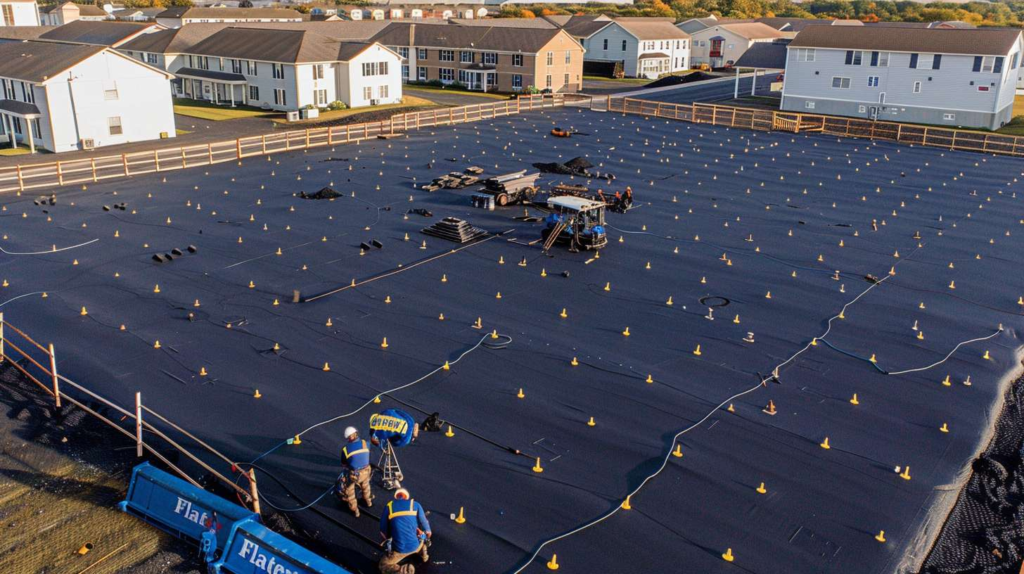
Before you choose fiberglass for a flat roof, what condition is the deck underneath actually in? It needs to be stable, dry enough to accept the resin properly, prepared to the right standard, and genuinely compatible with the system - not just "close enough." I'm Leah Morgenstern, and with 10 years installing fiberglass roofs for flat roof applications on Queens extensions, dormers, and small residential sections where detailing matters, I've seen what happens when contractors skip that assessment. A composite shell bonded to a compromised frame isn't a roof. It's a disguise - and an expensive one.
Decision Tree
Is Fiberglass a Good Candidate for This Flat Roof?
Is the roof small-to-medium, accessible, and structurally sound?
No → Evaluate other systems or carry out structural repair first before revisiting fiberglass.
Yes → Move to Step 2.
Is the deck stable and in suitable condition?
No → Substrate work must happen first. Do not apply fiberglass over a compromised deck.
Yes → Move to Step 3.
Are details like trims, edges, and penetrations manageable and buildable properly?
No → Reconsider system choice or redesign the detail build-out before committing.
Yes → Move to Step 4.
Can the work be installed and cured under proper conditions?
No → Wait for the right weather window. Rushing cure is one of the most common failure points.
Yes → Move to Step 5.
Strong fiberglass candidate. All conditions are in place for a durable, clean result.
What Makes Fiberglass Roofing Succeed
Fact 01
Sound Deck
The substrate must be stable, dry, and properly prepped. Everything the resin bonds to determines how the system performs.
Fact 02
Disciplined Detailing
Trims, upstands, edges, and penetrations must be built correctly - not approximated. Detail failure is where most fiberglass leaks begin.
Fact 03
Correct Resin and Mat Build-Up
The right mat weight, proper wet-out, and even resin application determine strength. Shortcuts in layup show up fast - and expensively.
Fact 04
Cure Conditions Respected
Rushed cure is one of the most underestimated failure points. Temperature, humidity, and timing must be respected - not squeezed into a tight schedule.
Clean Appearance Is the Part Homeowners Notice First - and the Part Bad Installs Hide Behind
I still remember that glossy roof that fooled the owner from the ladder. It was a July afternoon in Woodside - not far from the old elevated tracks on Roosevelt Avenue - and I'd been called out to inspect a fiberglass roof another crew had done. From street level, it caught the light and looked sharp. Once I got up there and ran my palm across the surface, the story changed. Dry patches, uneven matting, edge details clearly rushed ahead of an incoming storm. The owner looked at me genuinely confused and said, "But it shines, so I thought it was good." That's the real trap with fiberglass as a solution for flat roofs: a glossy topcoat can hide poor wet-out and bad workmanship long enough for the installer to be off the job and out of reach.
My opinion? People don't misunderstand fiberglass because it's weak - they misunderstand it because it looks too neat. A smooth, uniform finish feels like proof of quality, and sometimes it is. But it can just as easily be proof that someone applied a decent topcoat over rushed layup. In Queens, where a lot of small extension roofs and dormers get assessed from a ladder or a second-floor window, that ladder-view first impression carries too much weight. Homeowners in Astoria, Jackson Heights, and Jamaica are judging by shine before they've ever seen the edge work or tested the upstands. And here's the thing - waviness, print-through, dry patches, and weak edge detailing are all things a trained hand catches before the eye does. A glossy finish doesn't change what's underneath it.
Myth vs. Fact
Common Assumptions About Fiberglass Roofs for Flat Roofs
| Myth | Fact |
|---|---|
| "If it shines, it's well installed." | Gloss is a topcoat property, not a workmanship indicator. Poor wet-out, dry patches, and rushed layup can all live underneath a shiny surface coat. |
| "Fiberglass is basically cosmetic." | Done correctly, fiberglass is a fully structural waterproofing system - rigid, seamless, and bonded to the deck. It's as far from cosmetic as you can get. |
| "Any flat roof can take fiberglass." | Fiberglass requires a stable, suitable substrate. Applying it to an unsound or incompatible deck produces a good-looking failure, not a durable roof. |
| "Fast installation is a sign of skill." | Speed only means something when prep, layup, and cure are all done correctly. Rushing any of those stages is how fiberglass installs fail quietly and expensively. |
| "A seamless finish means the substrate doesn't matter much." | The seamless finish is a direct product of what it's bonded to. A compromised deck produces a compromised shell - the surface just hides it for a while. |
⚠ Surface Signs That a Fiberglass Roof May Only Look Good From a Distance
- Dry patches: Resin applied without proper wet-out - the mat hasn't fully bonded and the area is structurally weak.
- Uneven matting: Visible variation in surface texture that suggests the glass mat wasn't laid consistently or was moved before it set.
- Rushed edge details: Upstands, trim edges, and perimeter work cut short - often the first place water finds a way in.
- Visible waviness: Surface undulation that reveals the deck beneath wasn't level or that the resin was worked too late in its cure window.
- Print-through: The weave pattern of the glass mat showing through the topcoat - a sign of thin resin build-up or inadequate surface finishing.
- Work pushed ahead of weather or cure windows: If a crew was chasing a storm or racing a deadline, the result may look fine for now and fail within a season.
Awkward Corners, Trims, and Small Extensions Are Where Fiberglass Often Earns Its Reputation
The System Shines When Detail-Building Is Part of the Plan, Not an Afterthought
On a clean deck, fiberglass starts making a lot of sense. I remember a bright May morning in Bayside when a homeowner told me she liked fiberglass because it looked "tidy and modern" - which made me laugh, because tidy is the bonus, not the reason. Her rear extension had awkward corners and a history of little recurring leaks around the trims - the kind of drip that shows up every March no matter what anyone patches. Once I checked the deck and found it sound, I knew fiberglass roofs for flat roofs were the right call there. We could build the details properly, and the geometry of the extension, honestly, was exactly what fiberglass handles better than most systems. I spent half that visit explaining that fiberglass is unforgiving in the best possible way: it rewards disciplined preparation and exposes laziness with no ambiguity.
A fiberglass roof is a bit like a kayak hull - strong, sleek, and dependable, unless the shape underneath was wrong from the start. Before I got into roofing, I spent years building composite shells for racing kayaks in a workshop on the Hudson, and the logic is identical. The shell performs because the resin is correctly saturated into the mat, the mat is correctly laid over a prepared form, and the whole thing is given the time it needs to cure without interruption. Compress any of those steps and the rigidity you're counting on simply isn't there. The finish looks right, but the hand tells a different story - soft spots where full cure didn't happen, print-through where the build-up was thin, waviness where the substrate shifted. Fiberglass roofing at Flat Masters follows the same discipline: shell, substrate, resin, cure, and finish are all part of the same system.
Here's the blunt reality: fiberglass is excellent, and it is absolutely not forgiving. That combination is what makes the pre-job conversation so important. Ask every installer exactly what substrate prep, edge detail build-out, and cure timing are included in the quote - because those are the line items that quietly make or break the result and quietly disappear from cheap quotes. A number that leaves out proper deck assessment, trim build-out, and curing protocol isn't a competitive price. It's an incomplete job priced to look like a complete one.
Suitability Guide
Where Fiberglass Flat Roofing Tends to Be a Strong Fit vs. a Weak Fit
| Roof Situation | Fiberglass Fit | Why |
|---|---|---|
| Small rear extension | Strong | Manageable geometry, typically accessible, and deck condition is easy to assess. Detail work at edges and corners can be built properly without compromise. |
| Dormer roof | Strong | Small area with defined perimeter details suits fiberglass well. The system bonds tightly around upstands and flashings when installed with care. |
| Detached garage roof | Strong | Accessible, structurally contained, and often a simple deck layout. Provides a rigid, seamless, low-maintenance finish that ends the patch-and-pray cycle. |
| Heavily patched, unstable deck | Weak | Fiberglass bonds to what's there. An unstable or variable substrate produces a shell that flexes, cracks, and leaks - often in ways that are expensive to trace and fix. |
| Complex detail-rich small roof | Conditional | Fiberglass can handle complexity well - but only when details are planned and built properly from the start. If trims and penetrations are treated as an afterthought, it's the wrong system or the wrong installer. |
| Large, structurally questionable area | Weak | Fiberglass performs best on smaller, defined areas. Large roofs with structural questions need a thorough assessment and likely a different waterproofing system altogether. |
Installation Process
What a Quality Fiberglass Flat-Roof Installation Should Involve
Inspect and prepare the deck - assess structural integrity, moisture content, and surface compatibility before any resin or mat touches the roof.
Form details and trims correctly - upstands, perimeter edges, drip trims, and penetrations must be shaped and secured as part of the system, not added on afterward.
Apply resin and mat system evenly - proper wet-out across the full surface ensures the glass mat is fully saturated and bonded with no dry patches or thin areas.
Allow proper cure - the system must be given adequate time to cure within the correct temperature and humidity range before the topcoat is applied or the area is used.
Finish with a clean inspection of edges and surface continuity - run the surface by hand and eye before calling it done, checking for waviness, print-through, edge integrity, and any sign the resin didn't achieve full coverage.
Small Garage Roofs Can Be Ideal Candidates, But Only If the Frame Underneath Deserves the Shell on Top
Before you choose fiberglass for a flat roof, what condition is the deck underneath actually in? That question led to one of my favorite jobs - a garage roof in Maspeth where the customer had been storing old canoe paddles up there, which, not gonna lie, I appreciated immediately. It was a cool October day, the kind that actually cooperates with resin cure times, and he'd had it with the patch-and-pray cycle he'd been living through for three years. The roof was small, cleanly accessible, and structurally straightforward - exactly the combination that makes fiberglass the right answer. We talked for twenty minutes about why a rigid, seamless system works so well on the right flat roof structure. And then we talked about the other side: forcing fiberglass onto a poor substrate is just wrapping a bad frame in a nice shell. The shell doesn't fix what's underneath. It just delays when you find out.
Side-by-Side Comparison
Fiberglass on a Sound Garage Roof vs. Fiberglass Over a Poor Substrate
| Factor | Installed Over Sound Substrate | Installed Over Poor Substrate |
|---|---|---|
| Long-term performance | Rigid, bonded shell that performs consistently for many years with minimal intervention. | Degrading bond as the substrate moves or flexes - early cracking, lifting, and leaks. |
| Crack risk | Low - the shell has a stable base to bond to and doesn't flex under load. | High - movement in the substrate translates directly into stress fractures in the laminate. |
| Finish quality | Smooth, even topcoat with consistent sheen - the finish reflects the quality of the work below. | Looks acceptable initially, but print-through, waviness, and surface irregularities emerge as the substrate shifts. |
| Maintenance burden | Low - periodic inspection and the occasional topcoat refresh is typically all that's needed. | High - recurring cracks, edge failures, and leak chasing that often ends in a full system replacement. |
| Leak resistance | Excellent - seamless, bonded waterproofing with no joints to fail when details are built correctly. | Poor over time - cracks and delamination create entry points that are difficult to trace and repair. |
| Owner satisfaction | High - the system does what it promised, stays clean, and doesn't become a recurring expense. | Low - initial satisfaction fades quickly as problems surface, often within one or two winters. |
FAQ
Questions Homeowners Ask About Fiberglass as a Flat-Roof Solution
Why are fiberglass roofs for flat roofs so popular on small extensions?
Because small extensions offer exactly the conditions fiberglass needs: a manageable area, a contained perimeter, and enough accessibility to build details correctly. The system creates a seamless, rigid shell that ends the recurring leak-and-patch cycle that plagues extensions with traditional felt or sealant repairs. It's not that fiberglass is always better - it's that small extensions are often the ideal match for what fiberglass does well.
Is fiberglass better than repeated patching?
Almost always - if the deck is sound. Patching treats symptoms. Fiberglass replaces the waterproofing system entirely with a bonded, seamless shell that has no joints to fail. That said, fiberglass over a compromised deck is just a more expensive version of patching. The substrate has to be right first, or you're spending more to get the same eventual result.
What can go wrong with a fiberglass flat roof installation?
The most common failure points are poor wet-out (resin not fully saturated into the mat), rushed edge and trim details, inadequate substrate prep, and cure conditions that weren't respected. Any one of those produces a roof that looks fine initially and fails within a season or two - usually in ways that are expensive to diagnose because the surface hides the root cause. A glossy topcoat covers a lot of bad decisions, at least for a while.
How do I know the quote includes the important preparation work?
Ask directly. A good quote will spell out deck assessment and prep, edge and trim build-out method, resin and mat specification, and cure timing. If a quote jumps straight to price without addressing those steps, they're either not included or not planned. That's the quote to be cautious about - not competitive pricing, just an incomplete scope that will cost more to fix later than it saved upfront.
If you want a fiberglass roof quote that actually explains the deck condition, the detail work, and the cure plan - before anyone starts promising a tidy finish - give Flat Masters a call. We'll walk you through exactly what the job involves, what the roof needs, and whether fiberglass is genuinely the right answer for your situation.