
Beechhurst Queens Roofing - Waterfront Homes Need More Than a Basic Roofing Job
What did the quote say versus what was actually done? On Beechhurst waterfront homes, many roofing jobs fail not because the membrane was defective, but because the details around edges, drains, skylights, and wind-exposed transitions were never actually built for this location. This article is a reality check on flat roof services, repair limits, and what pricing is really telling you when the numbers look too clean.
Waterfront exposure changes what a "roofing job" really means
At 22 knots off the water, a roof starts telling the truth. The failures you see as interior stains and drips aren't random - they follow a pattern of ignored edge detail, blocked drainage, and unsealed penetrations. Most contractors who visit a leaking flat roof look at the field membrane and stop there. That's the wrong diagnostic. The right one traces cause, evidence, result - Darlene's framework for understanding why the failure exists, what the roof is showing you, and what happens if the actual cause goes unfixed. On a Beechhurst roof with salt air, lateral wind, and freeze-thaw cycles compounding every winter, that framework isn't optional.
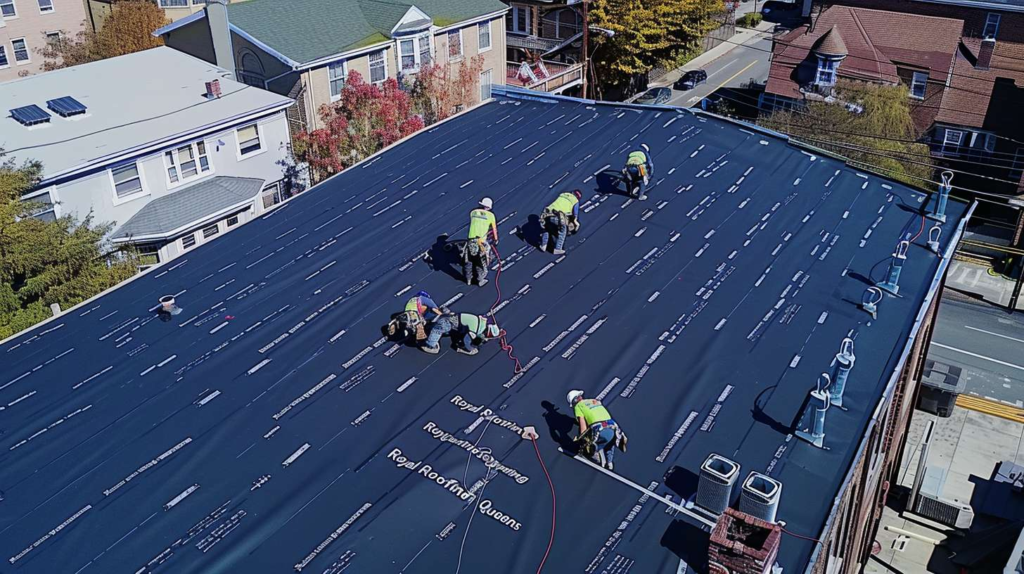
Here's my blunt opinion: a cheap flat roof repair or a suspiciously low flat roof replacement cost on a waterfront home in Beechhurst almost never means someone found efficiency - it means something important was left out of scope. I'm Darlene Velez, and I've been diagnosing flat roof failures in this neighborhood for 27 years, with a specialty in waterfront roofs that other contractors write off as simple age-related wear. The membrane is rarely where the story starts. Edges fail. Drains back up. Parapet caps crack. Skylight curbs get rebuilt wrong. And every one of those failures looks, from inside the house, like a "roof leak" - which makes it very easy for a contractor to patch twelve inches of membrane and call the job done.
Quick Facts: What Actually Matters on a Beechhurst Waterfront Flat Roof
💨 Wind Exposure
Sustained waterfront wind increases stress at every edge termination and perimeter seam - not just during storms, but across every season.
🧂 Salt Air Deterioration
Salt-laden air accelerates corrosion of edge metal, scuppers, and flashing fasteners - often years ahead of what inland roofs experience.
🌊 Drainage Defects
Standing water from poorly set drains puts constant tension on seam laps - eventually opening them from below, not above.
🔲 Detail Failures First
In most documented leak cases on waterfront homes, skylight corners, parapet caps, and edge terminations fail before the field membrane shows any visible damage.
Myth vs. Fact: What Homeowners Assume About Leaking Flat Roofs Near the Water
| Myth | Fact |
|---|---|
| "If the membrane looks fine, the roof is fine." | Edge securement, perimeter flashing, and drain connections can all be failing while the visible membrane surface looks intact. Waterfront roofs almost always leak at details first. |
| "A leak stain marks the exact entry point." | Water travels uphill under membranes and along substrate before it shows up as a stain. The actual entry point is frequently two to six feet from where the ceiling is wet. |
| "All flat roof services are basically the same." | Scope omissions are where the difference lives. A proposal that skips drain resets, parapet flashing, and edge metal isn't a comparable bid - it's an incomplete job at a low price. |
| "The lowest flat roof estimate saves money." | Low estimates on waterfront homes typically produce repeat leaks within one to two years, then a full replacement at a higher combined cost than doing the job correctly the first time. |
| "Wind only matters during storms." | Repeated wind exposure - even at moderate speeds off Powell's Cove - creates cumulative fatigue at edge terminations over time, not just single-event damage. This is why waterfront roofs degrade at details faster than field membrane. |
Where Beechhurst roofs usually fail before homeowners realize it
Skylight corners and curb rebuilds
I once lifted a seam near Powell's Cove and knew in three seconds that the "full flat roof repair" this homeowner had paid for covered maybe twelve feet of a forty-foot failure line. It was 6:40 in the morning, East River air was blowing sideways across the deck, and the seam I pulled back had never been properly reset - just surface-patched and covered. The original failure ran the entire back edge of that roof. Whatever moisture had been working under that membrane for months was still there, still moving. That's the cause. Now let's look at the evidence.
Drain bowls, edge metal, and parapet transitions
Cause, evidence, result: a leaking flat roof almost never enters where the homeowner is pointing. One November, right before dark, I got called to a home off Utopia Parkway Extension for a back bedroom where saucepans were sitting on the dresser catching drips. The homeowner had paid extra for a flat roof skylight upgrade the year before. But nobody rebuilt the curb correctly after that installation - and the water was entering at the corners of the curb, not through the glass at all. The husband kept pointing at the ceiling stain directly under the skylight frame. I kept pointing two feet uphill at the curb termination where the flashing lapped the wrong direction. Corners, curb flashings, edge terminations, and drain resets are where leaks begin. The field membrane is where they eventually show up - four weeks later, on your dresser, in a saucepan.
Stains lie. Details leak.
Open the Failure Map
Five hidden failure points on Beechhurst flat roofs - what they look like, why they happen, and what a real fix requires.
Pricing only makes sense after the scope stops pretending
If I were standing in your driveway, I'd ask you this first: does the quote in your hand include drains, edge metal, parapet detail, tear-off depth, insulation replacement, skylight curb work, and disposal - or does it say "repair flat roof" and list a number? A retired ferry worker once called Flat Masters after getting a suspiciously low flat roof replacement cost from another contractor. It was windy enough that afternoon to rattle my ladder against the gutter, and when I walked the roof, the scope gap was obvious: no parapet detail, no drain reset, no edge metal replacement anywhere in the proposal. He looked at the two quotes side by side and said, "So that price was fantasy?" I told him fiction has better structure. Those omissions weren't a bargain - they were a second replacement bill, arriving in about three years.
The insider move here is simple: don't compare totals, compare line items. Pull both proposals apart and check what's explicitly included and what's explicitly excluded. A serious flat roof estimate for a waterfront home will list tear-off depth, drain work, edge metal spec, membrane type, insulation inspection, parapet treatment, and warranty terms as separate line items - because each one costs money and each one matters. When a competitor leaves them blank, that's not savings. That's scope the homeowner is agreeing to pay for twice.
Common Flat Roof Cost Scenarios in Beechhurst
Ranges reflect local access conditions, exposure level, and detail complexity. These are estimates - not guarantees. Every roof requires on-site review before pricing.
| Scenario | Typical Scope | Estimated Range |
|---|---|---|
| Minor leaking flat roof repair at seam or flashing | Targeted seam adhesion, localized flashing reset, limited membrane patch | $350 - $950 |
| Flat roof repair cost per square (targeted membrane) | Per-square membrane repair with perimeter inspection included | $4 - $12 per sq. ft. |
| Residential flat roof repair with drain and edge corrections | Drain reset, edge metal refastening, membrane repair at multiple detail points | $1,800 - $5,500 |
| Garage flat roof replacement | Full tear-off, new membrane, edge metal, basic drain work on detached or attached garage structure | $2,500 - $7,000 |
| Full residential flat roof replacement (insulation + metal detail) | Complete tear-off to deck, insulation replacement where wet, new membrane, full edge and parapet detail work | $8,000 - $22,000+ |
| Commercial flat roof repair (small mixed-use building section) | Targeted commercial membrane repair, drain inspection, edge and parapet review on partial roof section | $3,500 - $14,000 |
What a Serious Flat Roof Estimate Should Show
| Quote Item | Why It Matters on Waterfront Homes | Red Flag if Missing |
|---|---|---|
| Tear-off / Removal | Wet layers left under new membrane trap moisture and accelerate deck rot | Means new membrane is going over unknown damage |
| Substrate Inspection | Salt and freeze-thaw damage to decking is invisible until membrane is removed | Deck deterioration will cause new membrane failure within 2-3 years |
| Drain Reset | Incorrect drain elevation causes ponding that stresses seams continuously | Ponding will return immediately regardless of new membrane quality |
| Edge Metal | Wind uplift on waterfront properties attacks edge terminations first - old metal undermines new membrane | Perimeter failure will begin immediately if old compromised metal is reused |
| Parapet Flashing | Parapet-to-roof transitions are a primary salt air failure point on Beechhurst homes | Wall leaks will develop within one to two seasons |
| Skylight Curb Rebuild | Curb corners are the most common single source of flat roof skylight leaks | Skylight will leak again within the first rain after installation |
| Insulation Replacement (if wet) | Wet insulation loses R-value and becomes a moisture reservoir that rots decking from below | Energy loss and ongoing structural damage if ignored |
| Membrane Type / Spec | TPO, EPDM, and modified bitumen perform differently in waterfront UV and temperature conditions | You can't evaluate quality or compare bids without knowing the spec |
| Warranty Terms | Labor warranty tells you how confident the contractor is in their own detail work | No warranty = no accountability for workmanship failures |
| Cleanup / Disposal | Old membrane and insulation add significant tonnage - disposal costs are real and should be disclosed | Surprise charges on invoice, or debris left for homeowner to handle |
Choosing repair, replacement, or maintenance without lying to yourself
When repair is still reasonable
A waterfront flat roof is less like a lid and more like a raincoat with weak cuffs. The middle can be perfectly fine while everything that connects it to the building is failing at the edges. Isolated repair makes sense when the membrane is generally stable, the failure is limited to one or two detail areas, and the substrate inspection confirms no widespread wet insulation. You'll want an honest assessment of how many detail failures exist before committing to repair - because if four or five transitions are compromised, the math shifts quickly toward replacement. Patching three of the five and calling it done is how leaks return on a schedule.
When replacement is the honest answer
Flat roof maintenance is a way to preserve a system that's still functioning - not a way to rescue one that's already compromised at the structure. A proper maintenance visit covers debris removal from drains, a seam review walking the field perimeter, drain flow confirmation, edge metal inspection, and a written log of any vulnerable details found that season. On a waterfront home, scheduling that twice a year - spring and late fall - catches the compounding effects of salt and freeze-thaw before they become repair bills. That's the evidence. Now here's the decision.
Decision Tree: Repair, Replacement, or Maintenance?
START: Is the leak tied to one specific detail area?
✅ YES → Proceed with targeted repair evaluation. Inspect that detail fully - curb, drain, seam, or edge - before pricing.
❌ NO → Continue below ↓
Are multiple edges, drains, or skylights involved in failure?
✅ YES → Move toward replacement evaluation. Multiple simultaneous detail failures indicate system-wide end of life.
❌ NO → Continue below ↓
Has this leaked more than once in the last 24 months?
✅ YES → Major repair or replacement warranted. Repeated leaks from the same system mean the cause was never resolved - only the symptom was quieted.
❌ NO → Continue below ↓
Is the insulation or substrate confirmed wet under the membrane?
✅ YES → Replacement required. Wet substrate cannot be encapsulated under new membrane without causing ongoing rot and failure.
❌ NO → Targeted repair is viable. Schedule a professional flat roof maintenance inspection to document the full condition before any work begins.
ENDPOINTS:
🔵 Routine maintenance | 🟡 Targeted repair | 🟠 Major repair with detail rebuilds | 🔴 Full replacement | ⚠️ Urgent inspection required
Flat Roof Maintenance Calendar for Beechhurst Homes
| When | Task | Why It Matters |
|---|---|---|
| Spring | Drain clearing and flow test; remove winter debris | Winter debris and leaf mat causes ponding that stresses seams through the wet season |
| Post-Storm | Edge metal and seam inspection after any wind event above 40 mph | Wind uplift opens edge terminations incrementally - catching it early prevents membrane intrusion |
| Late Summer | Full seam and blister review; document any membrane movement | Summer heat cycling reveals seam adhesion failures before fall rain season hits |
| Fall | Debris removal from all drains and scuppers; parapet cap sealant check | Blocked drains going into winter create ice dams at drain bowls that split seams from below |
| Winter | Interior ceiling check after freeze-thaw cycles; note any new stains | Freeze-thaw opens previously sealed detail failures - interior documentation helps isolate entry points for spring repair |
Questions worth asking before you hire anyone to touch the roof
Before you book anything, ask the contractor directly whether they've identified the cause, shown you the physical evidence on the roof, and explained what happens if the actual entry point goes unresolved. Not the symptom - the cause. If the answer is vague or skips straight to price, that's a signal. The best contractors working flat roofs in Beechhurst will walk you through what they found, where the water entered, and what the full scope covers - before you sign anything.
Before You Call: What to Have Ready When Booking Flat Roof Services in Beechhurst
- Leak history - when it first appeared, whether it's happened before, and whether it correlates with wind-driven rain specifically or all rain equally.
- Photos of ceiling stains and the roof surface - taken after the most recent event, not from six months ago. Fresh photos show active condition.
- Any prior quotes or repair invoices - knowing what was supposedly fixed previously tells the new contractor where to look for skipped work.
- Approximate roof age - even a rough estimate (original to the house, replaced in 2014, etc.) helps the inspector calibrate membrane life expectancy.
- Whether a skylight, drain, or parapet is involved - flagging known detail areas upfront saves diagnostic time and improves the accuracy of the scope discussion.
- Whether the leak is active during wind-driven rain - this distinction alone identifies edge or parapet entry versus field membrane or drain failure.
- Access limitations - narrow sideyards, no hatch, overhead utilities, or parking restrictions affect crew access and may affect scheduling and pricing.
Flat Roof Questions Beechhurst Homeowners Ask Most
⚠️ Warning: The Real Cost of a "Basic Roofing Job" on a Waterfront Home
Patching the visible symptom - without rebuilding the failed detail that caused the leak - doesn't close the problem. It traps moisture between layers, accelerates substrate rot, and adds compounding damage to a system that's now sealed over a wet foundation. What homeowners in Beechhurst often find is that two or three "basic" patch jobs over four years cost more in total than a proper repair would have the first time - and they still end up facing a full flat roof replacement cost on a deck that's now compromised from the inside out. Detail work isn't optional on waterfront homes. It's the job.
